
At Le Relais Plaza, history is not something kept behind glass. It is in the room itself, in the Art Deco lines that have remained almost intact for generations, in the regulars who still arrive with a precise idea of what they would like to eat, and in the particular energy of a Parisian brasserie that belongs to a palace without ever behaving like a formal hotel restaurant.
The dining room has always had its own rhythm. At lunch, it can feel almost like a neighbourhood address, populated by long-standing guests who return several times a week. By evening, it gathers another Paris: fashion, culture, business, hotel guests, friends meeting over a bottle, people who have come to celebrate. The atmosphere changes, but the restaurant retains the same quality: it remains a place where people come to eat well, to stay longer than planned and, above all, to return.
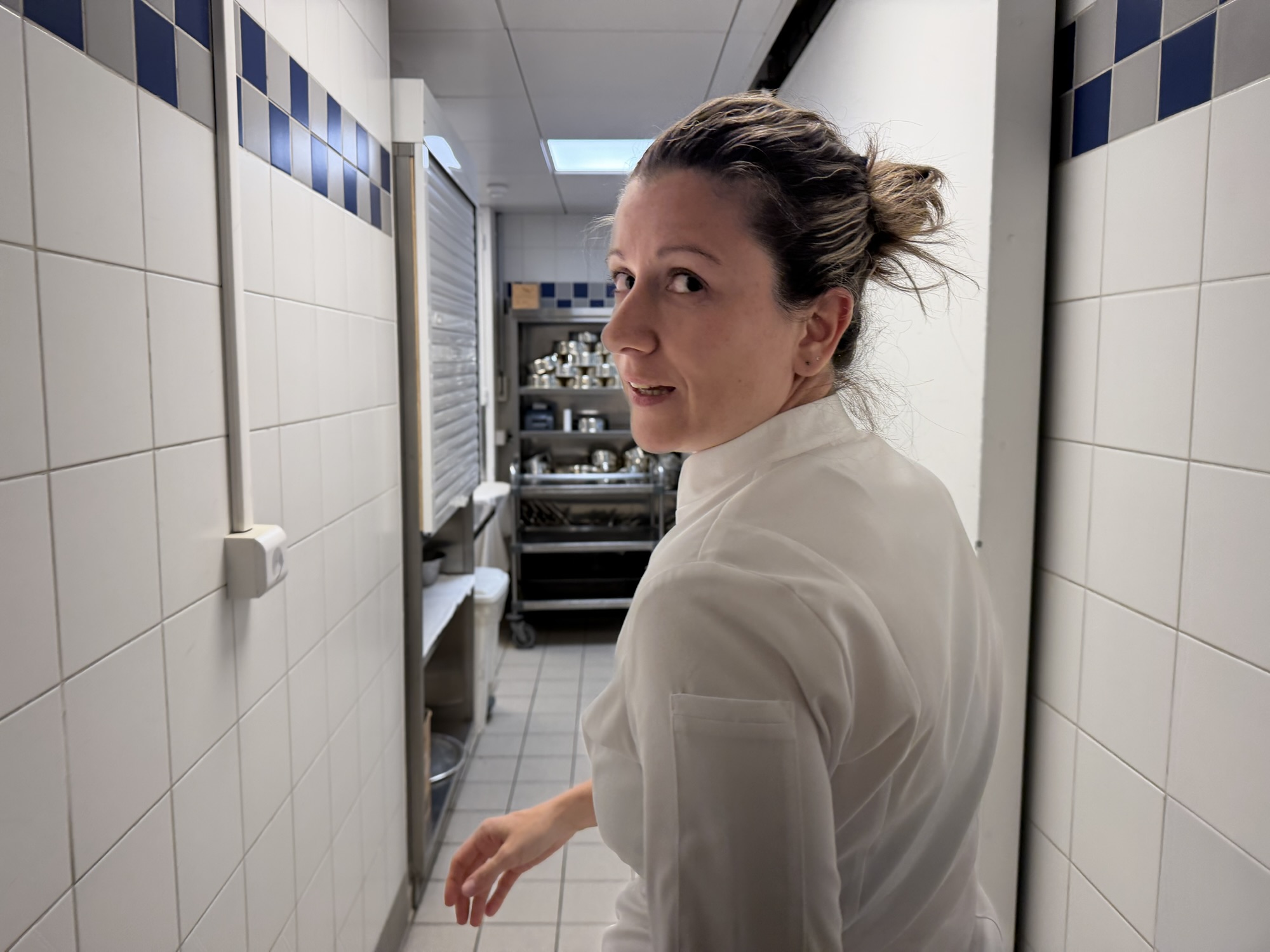
Today, the kitchen is led by Victoria Boller, the first woman to take charge of Le Relais Plaza, alongside Jocelyn Herland, Executive Chef of Hôtel Plaza Athénée. Their collaboration does not rest on the idea of starting again from zero. It is about understanding what the restaurant already is, protecting what made it matter to generations of diners, then finding the right way to move it forward.
Their paths had crossed years earlier in London, within the wider Alain Ducasse world. They did not work together then, but they had known each other long enough to recognise a shared way of looking at a kitchen: rigorous, demanding and ambitious, but never disconnected from the people who make it work.

For Victoria Boller, joining Le Relais Plaza was not an impulsive decision. After leaving Aux Lyonnais, she took time before committing to a new chapter. The prospect of taking responsibility for a kitchen inside one of Paris’s let’s say World’s most recognisable hotels was significant, but it was also coherent with the direction she wanted for herself.
“I did not hesitate,” says Victoria Boller. “It was a big challenge, but it was the right moment.”
That sentence carries more weight than it might appear to. Le Relais Plaza is not one restaurant among others. Its kitchen serves the brasserie, but also breakfast, room service and a substantial part of the hotel’s daily life. The pace is constant. A calm service in the dining room can still coincide with a demanding breakfast operation, dozens of room-service orders and the practical pressure of a palace that never really sleeps.
For Victoria Boller, taking over such a kitchen did not begin with changing a menu. It began with understanding people.
“You have to put yourself in everyone else’s position,” she explains. “You have to go through every section, understand how it works, get to know the people, then gradually bring in what you can.”
That approach says much about her leadership. It is not the language of a chef arriving with a personal manifesto and expecting everyone else to adapt. It is the language of someone who knows that a kitchen, particularly within a large hotel, has its own history, habits, skills and fragilities. Before transforming anything, she wants to understand the rhythm of the house.
The word that returns most often in her conversation is not authority, but composure. Victoria Boller speaks about the need to remain calm when information arrives from every direction, when the dining room is full, when there are last-minute changes, when teams are looking for answers and when the pressure naturally rises.

“You can deliver quality and rigour without becoming a tyrant,” she says.
It is a simple sentence, but it contains one of the most important shifts taking place in professional kitchens today. Excellence is no longer expected to justify behaviour that damages people. High standards remain non-negotiable, but the way in which those standards are transmitted matters just as much. Victoria Boller does not confuse calm with softness. She sees it as a responsibility. A chef has to make decisions, create order and protect the team from unnecessary anxiety.
That same conviction is shared by Jocelyn Herland, who has spent years navigating the complex ecosystem of large-scale luxury hospitality. For him, one of the essential questions is how to prevent the different kitchens of a palace from becoming separate worlds, each with its own hierarchy and sense of importance.
In the past, the gastronomic kitchen, the brasserie, banqueting, breakfast and room service could sometimes operate as distinct territories. Jocelyn Herland has worked to dismantle that logic. A cook working in the brasserie should not be treated as less capable or less valuable than someone working in fine dining. The skills are different, the pace is different, the pressures are different, but the standards must remain equally high.
At Le Relais Plaza, that principle becomes visible in the work itself. Preparing a great sauce, cooking a liver perfectly, producing a clear and concentrated jus, mastering a sole meunière, sending a precise plate at volume, or adapting a dish to a regular guest’s preferences are not secondary forms of cooking. They are the foundations of the métier.
“It is up to us to build them,” says Jocelyn Herland, speaking about young cooks and the frequent claim that the industry can no longer find sufficiently trained people. For him, recruitment cannot be reduced to waiting for perfect CVs. A house such as Hôtel Plaza Athénée has a responsibility to train, develop and give people the confidence to progress.
The hotel has built a system in which apprentices move through several stations, from breakfast and garde-manger to the different sections of Le Relais Plaza, room service, banqueting and snacking. It is a demanding structure, but it gives young cooks something increasingly rare: a complete understanding of how a large kitchen operates.
This attention to training also explains the restaurant’s approach to the menu. Le Relais Plaza does not treat its classics as museum pieces. The menu changes frequently, follows the seasons and evolves in response to the practical reality of the kitchen. Yet the restaurant refuses to abandon its identity in pursuit of novelty.

For Jocelyn Herland, the direction is clear: this is a Parisian brasserie. It should be generous, recognisable and rooted in French cooking. A guest should know why they have come. The restaurant does not need to become a collection of international references simply because trends change quickly elsewhere.
For Victoria Boller, this does not mean that personal expression disappears. It means that it takes time.
“A signature does not appear in two months,” she says. “It takes time. You bring your own touch, certain flavours, certain ideas, but it has to remain collaborative.”
That distinction matters. The cuisine at Le Relais Plaza is not built around a chef’s ego. It is built around the place. It must respect the setting, the history, the clientele and the expectations of a brasserie that has always been part of Parisian life.
The kitchen works from this shared framework. There is room for seasonal dishes, for changes in garnish, for new forms of presentation and for more contemporary techniques. But the guiding line remains legible: French brasserie cooking, made with precision, generosity and enough flexibility to remain alive.
Some dishes have become part of the restaurant’s recent memory. The sole meunière remains. The gratin de daurade has found its audience. There are also dishes that sound almost deceptively simple, such as the moules-frites, but which reveal the work and discipline behind the scenes.
At Le Relais Plaza, the mussels are not simply placed in a pot and sent to the table. They are carefully cooked, cooled, removed from their shells, arranged again with precision and served with a curry sauce. It is a dish that requires time, organisation and a willingness to give attention to something that many restaurants would treat as ordinary.
That is one of the paradoxes at the heart of the house. The food is designed to feel easy, but it is not easy to produce. The service is meant to appear effortless, but it depends on an extraordinary amount of coordination. A guest may come in asking for a grilled fillet of beef with green beans, fries or a specific sauce. At Le Relais Plaza, the request is not treated as an inconvenience. It is part of the job.

The point is not to say yes to everything without thinking. It is to understand the difference between generosity and disorder. Jocelyn Herland believes that a kitchen should be able to adapt, but it must also be honest about what it can do well. If a request requires time, the team should say so. If a dish needs preparation, it should be given the time it deserves. Luxury, in that sense, is not unlimited availability. It is the ability to make the right decision without disappointing the guest.
That idea also shapes the atmosphere of Le Relais Plaza. The restaurant is expensive, and it does not pretend otherwise. But neither Victoria Boller nor Jocelyn Herland describe its value through price alone. The value lies in the complete experience: the room, the service, the food, the wines, the familiar faces, the memory of previous meals and the sense that the restaurant can still belong to different people at the same time.
A long-standing regular may come for a simple grilled fillet of beef, prepared exactly as he likes it. A younger guest may arrive with friends to open a magnum and celebrate. A designer from the neighbourhood may sit near a hotel guest who has travelled from another continent. The room has room for all of them.
That is perhaps what makes Le Relais Plaza more than a brasserie inside a palace. It is a restaurant that still behaves like a restaurant. It has its rituals, its regulars, its changing moods and its own social life. It is elegant, but it is not frozen. It is historic, but it is not nostalgic.
With Victoria Boller in the kitchen and Jocelyn Herland shaping the wider culinary vision, the ambition is not to make Le Relais Plaza louder, more fashionable or more theatrical. It is to make it stronger.
The food must remain generous. The kitchen must remain demanding. The teams must continue to grow. And the guests must leave with the sense that they have not simply eaten in an iconic dining room, but spent time in one of Paris’s living places.
Leave a Reply