
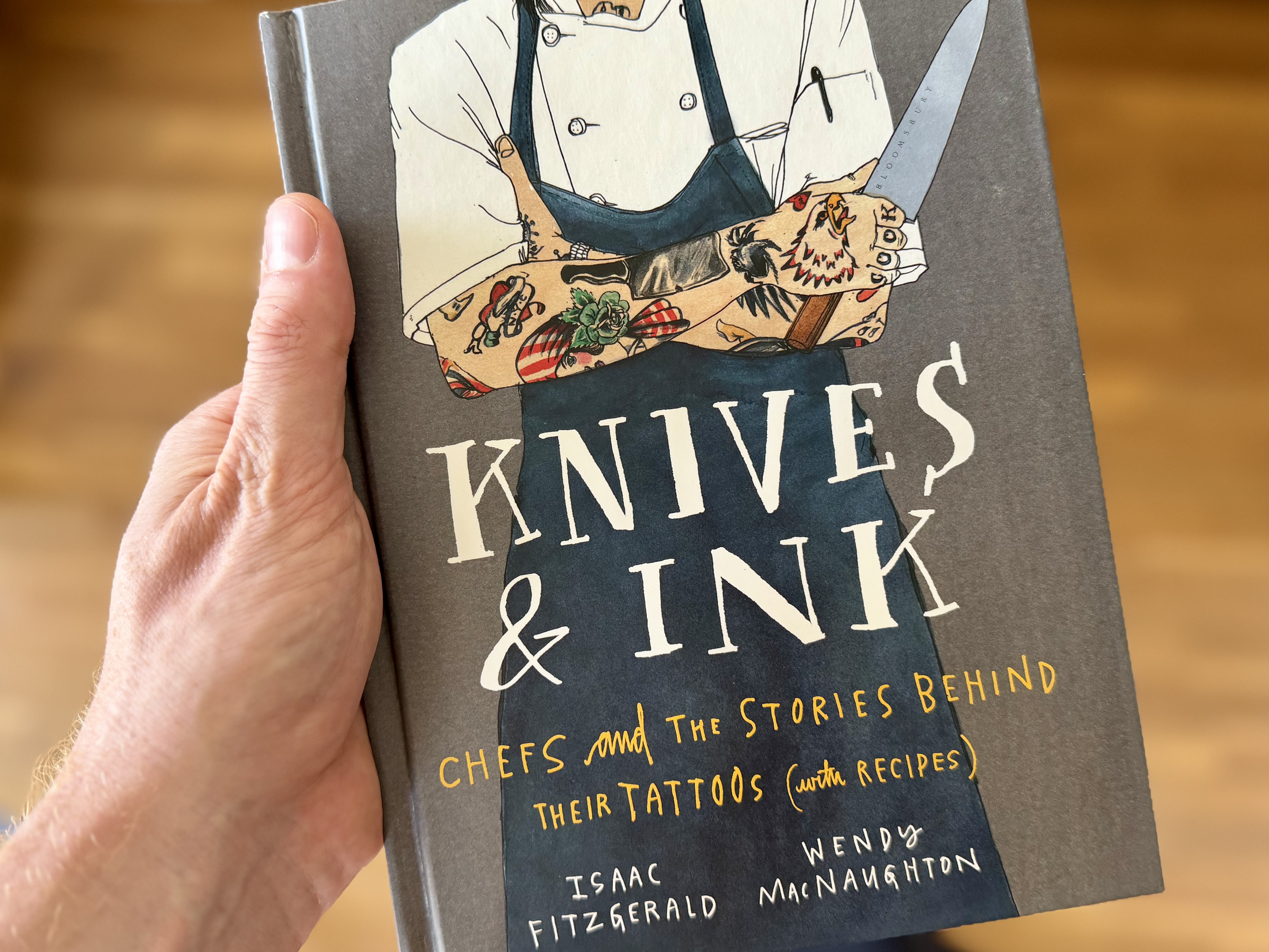
I bought Knives & Ink several years ago, almost by chance. It has followed me ever since, moving from shelf to shelf while countless other books about chefs and restaurants have come and gone. Published in 2016 by Bloomsbury, the book brings together writer Isaac Fitzgerald and illustrator Wendy Mac Naughton around an idea of disarming simplicity: telling the stories of chefs through the tattoos they carry on their bodies. More than sixty-five of them appear across its pages, from celebrated names to line cooks whose careers have unfolded far from the spotlight.
Almost ten years after its publication, I still struggle to find another book quite like it. Perhaps because Knives & Ink understood something about chefs before the tattooed chefs became such a familiar figure: ink in a kitchen is rarely just decoration. Under the jacket, behind the apron and across forearms marked by burns and cuts, tattoos become fragments of biography. Family, death, love, addiction, migration, faith, mistakes, survival, food and ambition all find their way onto the skin. Isaac Fitzgerald and Wendy Mac Naughton use those marks as entrances into lives that would otherwise remain largely invisible.

The format gives the book much of its strength. Wendy MacNaughton does not simply photograph the tattoos. She redraws them, along with the bodies carrying them, using loose lines, handwritten typography and touches of colour. Isaac Fitzgerald allows the chefs to explain what those images mean. Portrait, tattoo, memory and occasionally a recipe share the page. The result feels closer to a notebook passed around after service than to a conventional chef book. That choice was recognised with an IACP Cookbook Design Award, and it remains one of the reasons the book has aged so well.
There is no hierarchy here between the famous chef and the anonymous cook. That matters. Knives & Ink moves through American kitchens without reducing their world to the handful of personalities normally used to represent it. The original cast ranges from James Beard Award winner Jamie Bissonnette to Mandy Lamb, who cooked aboard an Alaskan fishing boat, alongside restaurant owners, pastry chefs, sous-chefs and line cooks. Their tattoos create another map of the profession, one drawn from personal histories rather than Michelin stars or restaurant rankings.

Dominique Crenn recounts the accident that nearly killed her when, exhausted after working seven days a week as a hotel chef, she slipped in the shower, severed a tendon and lost consciousness. The tattoo that followed became connected to survival, to the tension between struggle and hope, dream and reality, and to the conviction that life cannot endlessly be postponed. On the opposite page, Wendy MacNaughton draws Crenn’s arm, the tattoo and a plate almost as parts of the same composition. The chef’s body and the food she creates suddenly belong to the same biography.
Elsewhere, Tim Archuleta’s dragons trace a path through Catholic school, Buddhism, marriage and the balance he sought between different parts of his life. Michael David Mann’s Eye of Horus begins with ancient Egypt and eventually becomes intertwined with love, separation and reunion. Anna Barie carries a small symbol on her finger connected to a friend and to a life rebuilt after leaving Paris for Los Angeles. Anthony Strong’s arm becomes a travelogue of Naples, restaurant kitchens and the objects and images collected along the way. Soleil Ho’s paddy crab returns to Vietnamese roots, ingredients and ancestry. Brian Grosz speaks about Japanese imagery, family and permanence. The motifs could hardly be more different, yet page after page the same idea emerges: a tattoo can hold a chapter of someone’s life in a few centimetres of skin.

Food is never far away and recipes punctuate the portraits but they do not interrupt the stories; they extend them. A recipe becomes another form of memory, another way of understanding where someone came from and what he or she chose to carry forward.
That may explain why Knives & Ink still feels so relevant today. The tattoo is the subject announced on the cover, but the book is really interested in what kitchens leave on people. There are the visible marks as ink, burns, scars and all the others… Long services, friendships, failures, obsessions, departures, mentors, countries crossed, people lost and dishes remembered. The body becomes an archive of a profession that is often described through plates while the people making them remain partly hidden.
There is also something particularly accurate about choosing tattoos to tell the story of cooks. A plate exists for a few minutes before being eaten. Restaurants change, menus are rewritten and careers move from one kitchen to another. A tattoo stays. In Knives & Ink, that permanence creates a counterpoint to the ephemeral nature of the profession. What vanished from the menu may still exist on an arm twenty years later.
Isaac Fitzgerald and Wendy Mac Naughton had already explored tattoos and personal narratives together in Pen & Ink. For this second project they narrowed their attention to kitchens, gathering stories from cooks across the United States and turning them into a 208 illustrated pages book. What could easily have become a catalogue of tattooed chefs instead became a collective portrait of restaurant culture.
Looking through my copy again years after buying it, what strikes me is how little the book needs to explain itself. The drawings, handwriting, recipes and voices coexist with an almost handmade freedom. Some pages are crowded, others nearly empty. A tattoo can occupy an entire spread; elsewhere a few handwritten sentences carry the story. That apparent looseness hides a remarkably coherent piece of editorial design.
Many books have since documented chefs, their restaurants, their dishes and their philosophies but nearly a decade later, I have yet to find its real equivalent to Knives & Ink.
And perhaps that is why it is still on my shelf.
Leave a Reply