
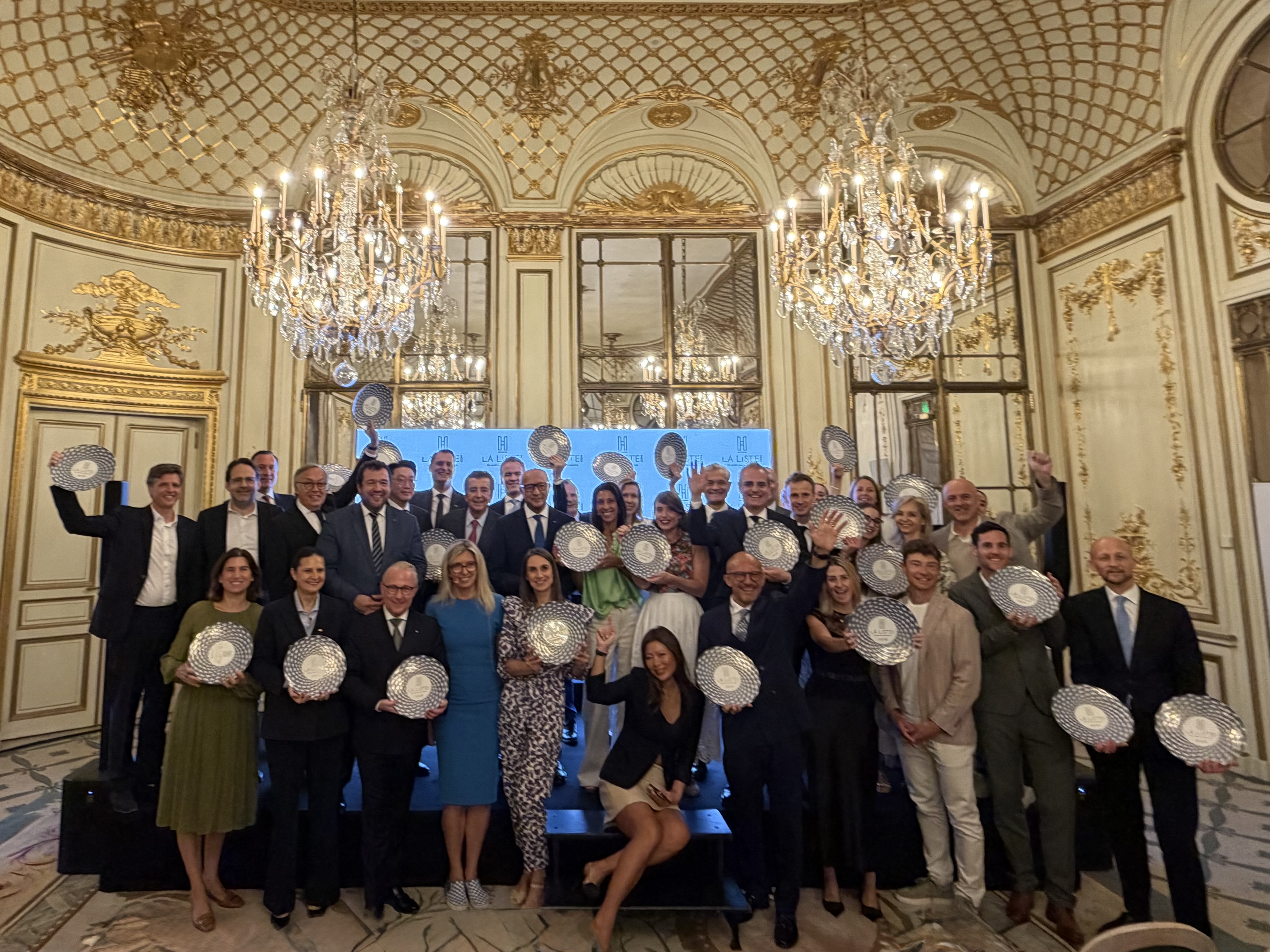
The third edition of LA LISTE Hotels was unveiled in Paris, inside the Salon Joséphine of Le Meurice, bringing together hoteliers, chefs, institutional figures and leading voices from the world of travel.
For the first time, the hotel ranking was celebrated through a dedicated ceremony, confirming the growing place of hospitality within the LA LISTE universe. After restaurants and pastry, hotels now occupy a central role in the institution’s global reading of excellence.
“Hospitality is now a strategic pillar of LA LISTE, alongside gastronomy.”
Founded on an aggregation method that combines guides, rankings, media sources and expert opinions, LA LISTE Hotels does not only publish a hierarchy. It also offers a way of reading the evolution of luxury hospitality. This 2026 edition is therefore both a prize list and a snapshot of an industry in transformation.
The 2026 edition places ten hotels at the summit of the ranking. Each reflects a different interpretation of contemporary hospitality: palace culture, family transmission, urban precision, destination luxury, service, gastronomy and emotional memory.
- Badrutt’s Palace Hotel — St. Moritz, Switzerland
An alpine icon where family independence, historical prestige and the art of winter hospitality continue to shape one of Europe’s great hotel legends. - Il San Pietro di Positano — Positano, Italy
A hotel suspended between cliff and sea, embodying Italian hospitality through discretion, family spirit, landscape and a deeply personal sense of welcome. - La Réserve Paris — Paris, France
A Parisian palace built on intimacy, precision and discretion, closer in spirit to a private residence than to a traditional grand hotel. - Las Ventanas al Paraíso, A Rosewood Resort — Los Cabos, Mexico
A resort where service, anticipation and the strength of the landscape create a complete emotional experience. - Le Meurice — Paris, France
One of the great Parisian institutions, combining palace heritage, French elegance and a strong sense of continuity. - Mandarin Oriental Bangkok — Bangkok, Thailand
A reference of Asian hospitality, where service culture, river life and historic depth continue to define an international benchmark. - One&Only Portonovi — Herceg Novi, Montenegro
A destination hotel illustrating the rise of new luxury territories and the growing power of emerging hospitality geographies. - The Peninsula Chicago — Chicago, United States
An urban hotel defined by consistency, precision and a contemporary interpretation of service. - The Peninsula Shanghai — Shanghai, China
A property where Art Deco heritage, city culture and international luxury meet with remarkable coherence. - Cheval Blanc Paris — Paris, France
A contemporary Parisian address where fashion culture, design, gastronomy and service form a highly controlled vision of luxury.

Alongside the main ranking, LA LISTE Hotels also awarded a series of special prizes. These distinctions reveal some of the strongest movements shaping hospitality today: innovation, transformation, design, responsibility, openings, exploration and the renewed importance of service.
Prix du changement: Zannier Bendor – Île de Bendor, France
A hotel and group project focused on transformation, renewal and a new relationship between place, hospitality and destination.
Prix de l’innovation: Tulah Clinical Wellness – Kerala, India
A wellness-focused project reflecting the growing importance of health, longevity and medical hospitality in the luxury sector.
Openings of the year
- Grand Hôtel de Djokja – Yogyakarta, Indonesia
- The Chancery Rosewood – London, United Kingdom
- Rosewood Courchevel Le Jardin Alpin – Courchevel 1850, France
- Aman Nai Lert Bangkok – Bangkok, Thailand
- One&Only Moonlight Basin – Montana, United States
These openings show the diversity of current hotel development, from heritage restoration to mountain luxury, urban reinvention and large-scale destination projects.
Hotels to explore
- Islas Secas Private Island – Gulf of Chiriquí, Panama
- The Six Bells – New York, United States
- Arctic Bath – Lapland, Sweden
- La Source de Vougeot – Vougeot, France
- Cangtel Lodge – Paro, Bhutan
This category highlights hotels that invite travel differently. Some are remote, some discreet, some rooted in heritage or nature. Their strength lies in their capacity to create curiosity before they create fame.
Price of style and design
- The Emory – London, United Kingdom
- Capella Kyoto – Kyoto, Japan
- Mandarin Oriental Qianmen Beijing – Beijing, China
- Airnelles Venezia – Venice, Italy
- Art Paradiso – Paradise City, Incheon, South Korea
Here, design is not treated as decoration. It becomes a way of defining the identity of the hotel, shaping the guest experience and creating a visual language that can travel beyond the property itself.
Price of social responsibility
- Grootbos Private Nature Reserve — Gansbaai, South Africa
- Sonéva Secret — Noonu Atoll, Maldives
- Waldorf Astoria Costa Rica Punta Cacique — Playa Penca, Costa Rica
- Auberge du Père Bise — Talloires-Montmin, France
- Don Alfonso 1890 — Sant’Agata sui Due Golfi, Italy
This prize reflects a major shift in luxury hospitality. Environmental responsibility is no longer an optional narrative. It is becoming part of the credibility of high-end hotels.
Price of hospitality : Don Alfonso 1890 – Sant’Agata sui Due Golfi, Italy
A distinction that places the human relationship at the centre of the hotel experience, reminding us that service remains the most difficult luxury to reproduce.

During the ceremony, Philippe Faure, founder and president of LA LISTE, returned to the method behind the ranking. LA LISTE was born ten years ago in the restaurant world, with one ambition: to offer a global reading of excellence by aggregating multiple sources.
“The idea was to have a synthetic vision of what is happening.”
The same method now applies to hotels. LA LISTE gathers guides, rankings, press articles, reviews and international references, then processes them through a weighted algorithm. The purpose is not to replace the experience of travel, but to identify the signals that structure the industry.
“We gather all these sources and make a synthesis.”
This approach gives LA LISTE Hotels a specific position. It is not a jury prize in the traditional sense. It is an attempt to read a fragmented world through data, editorial interpretation and global observation.
Philippe Faure also insisted on the importance of the trend report accompanying the ranking, describing it as a way to understand not only who is winning, but why the market is changing.
“It is a sociological work, in a way.”

The 2026 edition shows that luxury hospitality has entered a more complex period. The finest hotels are no longer judged only by prestige, location or price. They are judged by their ability to create a coherent world.
A great hotel today must combine architecture, service, gastronomy, design, privacy, local culture, wellness and emotion. It must be able to tell a story without forcing it. It must be rooted in its place without becoming folkloric. It must be international without becoming anonymous.
This is perhaps the clearest lesson of the ranking: the best hotels are those that cannot be easily copied.
Luxury is no longer only about accumulation. It is about precision. The right light. The right rhythm of service. The right distance between attention and discretion. The right table at breakfast. The right silence in a corridor. The right gesture at arrival.
One of the strongest ideas in the trend report is the role of people. Technology is transforming the hotel experience, from reservations to guest preferences. But the finest hotels still depend on human intelligence.
“Luxury hospitality remains fundamentally a human industry.”
This sentence carries particular weight in the current context. Recruiting, training and retaining teams has become one of the great challenges of hospitality. Yet the expectations placed on staff have never been higher.
In a palace or a luxury resort, service is no longer only technical. It is emotional. It requires precision, memory, discretion, cultural awareness and the ability to understand a guest without reducing them to a profile.
The most memorable hotels are often those where service becomes personal without becoming intrusive. A guest returns not only for a suite or a view, but for a feeling of recognition.
Another major movement highlighted by LA LISTE Hotels 2026 is the growing power of hotels as destinations in themselves.
Some properties no longer depend only on the city, coast, mountain or island around them. They become the reason for the journey. This is visible in private islands, remote lodges, wellness retreats, restored palaces and architectural resorts.
In this sense, hotels are following a path already seen in gastronomy. Some restaurants are no longer simply places to eat. They justify travel. The same is now true for hotels. A room, a garden, a view, a breakfast, a bar or a spa can become part of a larger ritual.
At its best, a hotel does not interrupt the journey. It becomes the journey.

The ceremony also confirmed the growing relationship between hotels and gastronomy. In the luxury segment, food is no longer an additional service. It is a defining element of identity.
A hotel restaurant can bring prestige, but that is no longer enough. The strongest properties now build complete culinary ecosystems: fine dining, casual dining, breakfast, bar, pastry, room service, wellness menus, local sourcing and sometimes even farm-based models.
This is why chefs now play a strategic role in hospitality. They help define the tone of a hotel. They give taste to a place. They transform the experience from accommodation into culture.
Philippe Faure reminded the audience that tastes have changed, and that the offer itself has changed. LA LISTE Hotels 2026 captures precisely this movement: the transformation of hospitality through food, design, service and place.
The trend report identifies several major movements shaping the future of luxury hospitality. Five stand out clearly.
- Structural value: Luxury must be built on a complete ecosystem: architecture, service, gastronomy, location, memory and culture.
- Visible but discreet prestige: Exclusivity no longer needs to be loud. It must be felt through detail, access and atmosphere.
- Human capital: The ability to recruit, train and retain qualified teams is becoming one of the main markers of excellence.
- Individual climates: Guests expect hotels to understand their rhythm, preferences and expectations without turning personalisation into intrusion.
- Direct operation as strategy: Seasonality, regional closures, geopolitical shifts and changing travel flows are forcing hotels to rethink their models.
These ideas reveal a clear direction. The hotel of tomorrow will have to be more precise, more personal, more responsible and more coherent.

LA LISTE Hotels 2026 confirms that hospitality has become one of the key cultural fields of our time. Hotels are now and more than ever places where architecture, gastronomy, service, finance, design, ecology, tourism and emotion meet.
This third edition shows an industry searching for balance. Between growth and identity. Between global visibility and local meaning. Between technology and humanity. Between performance and memory.
The great hotels of tomorrow will not simply be the most expensive, the most beautiful or the most famous. They will be the ones capable of creating a language of their own.
A language made of people, place, food, silence, time, architecture and care. A language that begins at the door, continues at the table, settles in the room and remains long after departure.
Leave a Reply