
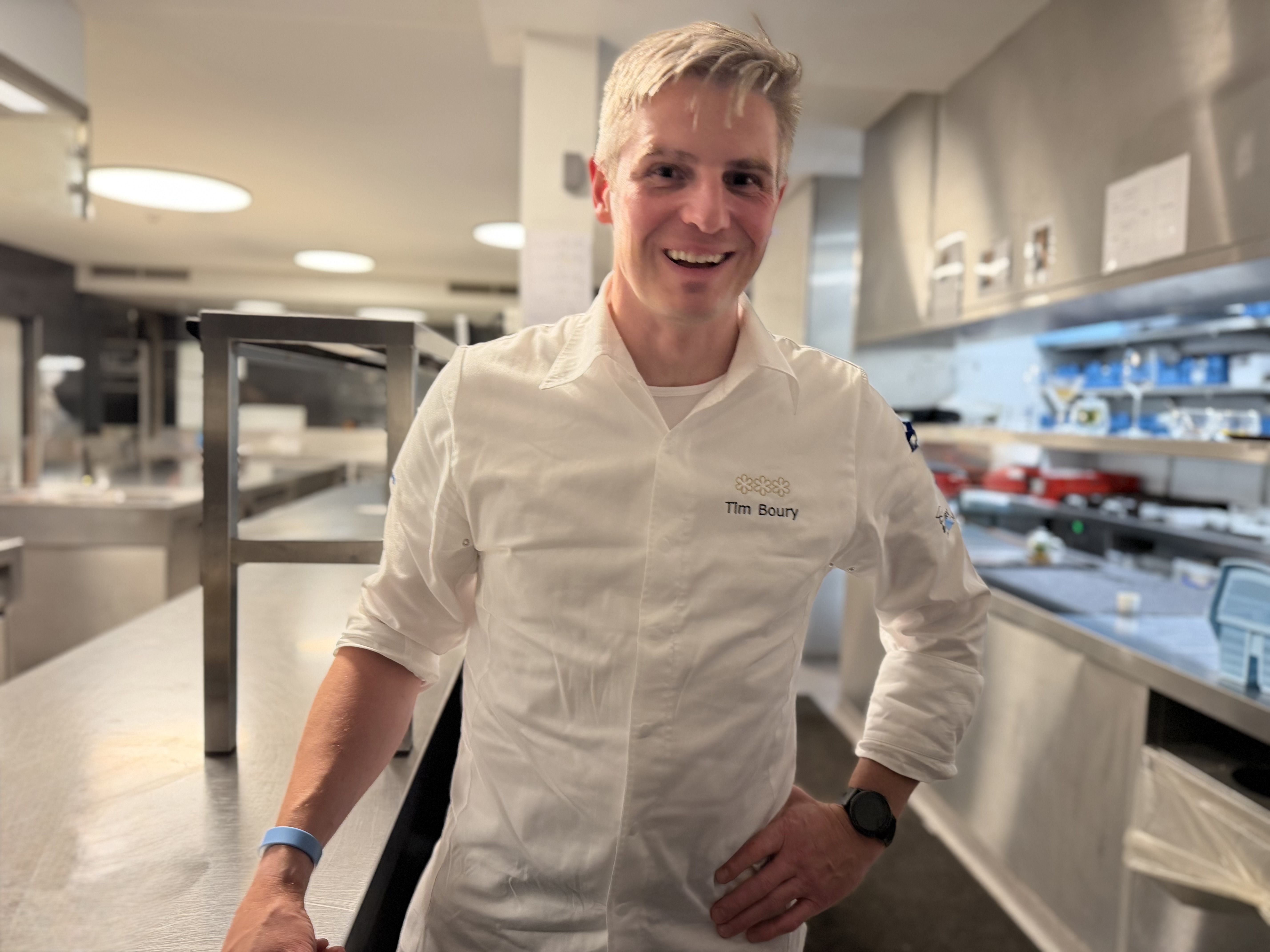
A few kilometres from the French border, in Roeselare, Boury does not try to convince you that it belongs among the great restaurants of Europe. It simply behaves like one.
There is something almost disarming about this. In a gastronomic world often tempted by explanation, concepts, excessive storytelling and visible ambition, Boury chooses another path. The house lets the plate speak first. Then the service. Then the wine. Then the silence that follows a perfectly balanced bite.
Since 2022, Tim Boury’s restaurant has held three Michelin stars. In Belgium, where the highest distinction remains rare, Boury occupies a particular place: not as a monument frozen in its status, but as a living house — precise, elegant, confident, deeply connected to its products and to the pleasure of receiving guests.
Boury is led by chef Tim Boury, alongside Ben Boury and Inge Waeles, supported by dining room and wine teams that contribute fully to the experience. This matters, because what unfolds here is not merely a demonstration of cooking. It is a complete expression of what a great restaurant can become when nothing feels forced.

A cuisine that does not need to raise its voice
The most striking quality of Boury’s cuisine is its clarity.
Every dish is sophisticated, sometimes technically demanding and often constructed through several layers of flavour, yet nothing feels blurred. The intention remains clear. The product is always identifiable. The sauce supports the composition. The seasoning gives it direction. The cooking is precise without becoming rigid.
This is perhaps one of the hardest achievements in gastronomy: reaching a high degree of complexity while preserving complete readability.
At Boury, everything seems to flow naturally. That does not mean the cuisine is simple. It means the work has been taken far enough for the effort to disappear.
The meal tasted was built around the following sequence:
- Calamar, koji, togarashi, radis
- Wagyu et Grevenbroecker
- Thon Bluefin, daikon, raifort
- Aji amarillo, concombre, céleri, gingembre, brioche provençale
- Gambero Gobetto, ceviche, tomate, blette, maïs, jalapeño
- Asperge blanche bio, truite arc-en-ciel, cresson, amande, vieux fromage de Roulers
- Turbot de la mer du Nord, fenouil, lavande de mer, anguille fumée, pomme verte
- Caviar Osciètre, bonnotte, crabe, crevettes grises, vin jaune
- Homard de l’Escaut, nduja, fèves, oignon de Roscoff, petits pois
- Ris de veau, courgette, morilles, truffe noire
- Agneau de lait du Pays basque, courgette, cèpes et girolles
- Vacherin, rhubarbe, thym citron et fleur de sureau
- Variétés de fraises, mascarpone Zucchelli, sumac, babeurre et verveine
Beyond the individual dishes, what stands out is the consistency of the entire menu. There are no weaker passages, no plates that seem to exist merely as transitions, and no moments when the experience loses its direction. The meal progresses with precision, moving between freshness, depth, intensity and generosity without ever becoming repetitive.
This absence of false notes is perhaps what most clearly defines Boury. Many restaurants are capable of producing one remarkable dish. Far fewer can maintain the same degree of attention, accuracy and pleasure throughout an entire tasting menu.

The product as a foundation, not as an argument
Many restaurants speak about the product. Boury cooks it.
Seafood, vegetables, meat, cheeses and condiments are treated with the same seriousness. The product is never reduced to a pretext for technique. It remains at the centre of the plate, supported by precise cooking and carefully considered accompaniments.
The cuisine draws on different regions and culinary cultures, but it never feels like a collection of references. Tim Boury uses these influences freely, without allowing them to distract from the identity of the restaurant.
What matters is not where an ingredient or technique comes from, but what it contributes to the dish. The result is a cuisine that feels contemporary without chasing novelty: open, curious and technically ambitious, but always disciplined.

The sweetbread as a defining moment
If one dish had to remain, it would probably be the Ris de veau, courgette, morilles, truffe noire.
Some dishes mark a meal because they arrive at precisely the right moment. Others because they reveal the full intelligence of a kitchen. This one does both.
The sweetbread is cooked with remarkable precision. It carries that rare combination of crispness and softness, immediate pleasure and lingering depth. Served warm at its centre, it delivers the full richness and delicacy of the product. It is a dish of considerable generosity, but also of discipline.
Above all, it is one of those rare plates that remains in the memory long after the meal has ended. Not because it tries to surprise at all costs, but because everything feels exact: the cooking, the seasoning, the texture and the balance.
Quite simply, it was one of the most memorable sweetbread dishes we have tasted in recent years.

Service as part of the cuisine
A three-star restaurant cannot be judged by the kitchen alone.
At Boury, the service plays a decisive role. From the first moment to the last, it gives the meal rhythm, comfort and confidence. It is attentive without becoming heavy, precise without becoming distant. The dining room understands that elegance is not a matter of posture. It is a matter of timing.
A great dining room should never become a performance separate from the food. It should create the conditions in which the cuisine can be fully understood and enjoyed. At Boury, this happens naturally.
The same can be said of the wine pairings.
The sommellerie accompanies the meal with remarkable accuracy. The wines do not compete with the plates. They do not try to dominate the experience or prove a point. They extend the dish, reveal another angle, bring freshness where the plate has depth, tension where it has roundness, and calm where intensity has already done its work.
This is the mark of thoughtful wine service: the pairing is present, but it remains at the service of the overall experience.
The pleasure of being received
Boury is undoubtedly a major gastronomic house. It has the products, the technical mastery, the consistency and the level of service expected from a three-star restaurant. But reducing it to these qualities would overlook something essential.
Boury is also a place where the experience never feels mechanical or intimidating. Despite the sophistication of the cuisine and the precision of the service, a genuine sense of generosity remains. The restaurant understands that hospitality is not an accessory to gastronomy. It is one of its foundations.
This may ultimately be what distinguishes a great restaurant from a technically impressive one.

The archetype of a great restaurant
There are no obvious weaknesses across the menu. No unnecessary effects. No moments when technical ambition replaces taste. Each course contributes to the progression of the meal, and every part of the restaurant appears aligned with the same standards.
This is the archetype of what a great restaurant should be. Not simply a succession of impressive plates, but a complete experience in which cuisine, wine, service and hospitality form a coherent whole.
At Boury, excellence does not need to raise its voice. It can be felt in the cooking of a sweetbread, the depth of a sauce, the precision of a pairing or the quiet confidence of the dining room team.
Throughout the meal, one idea gradually becomes clear: when a restaurant reaches this level of precision while preserving such a sense of naturalness, there is very little left to explain.
Perhaps that is the finest thing one can say about a three-star restaurant.
Leave a Reply