
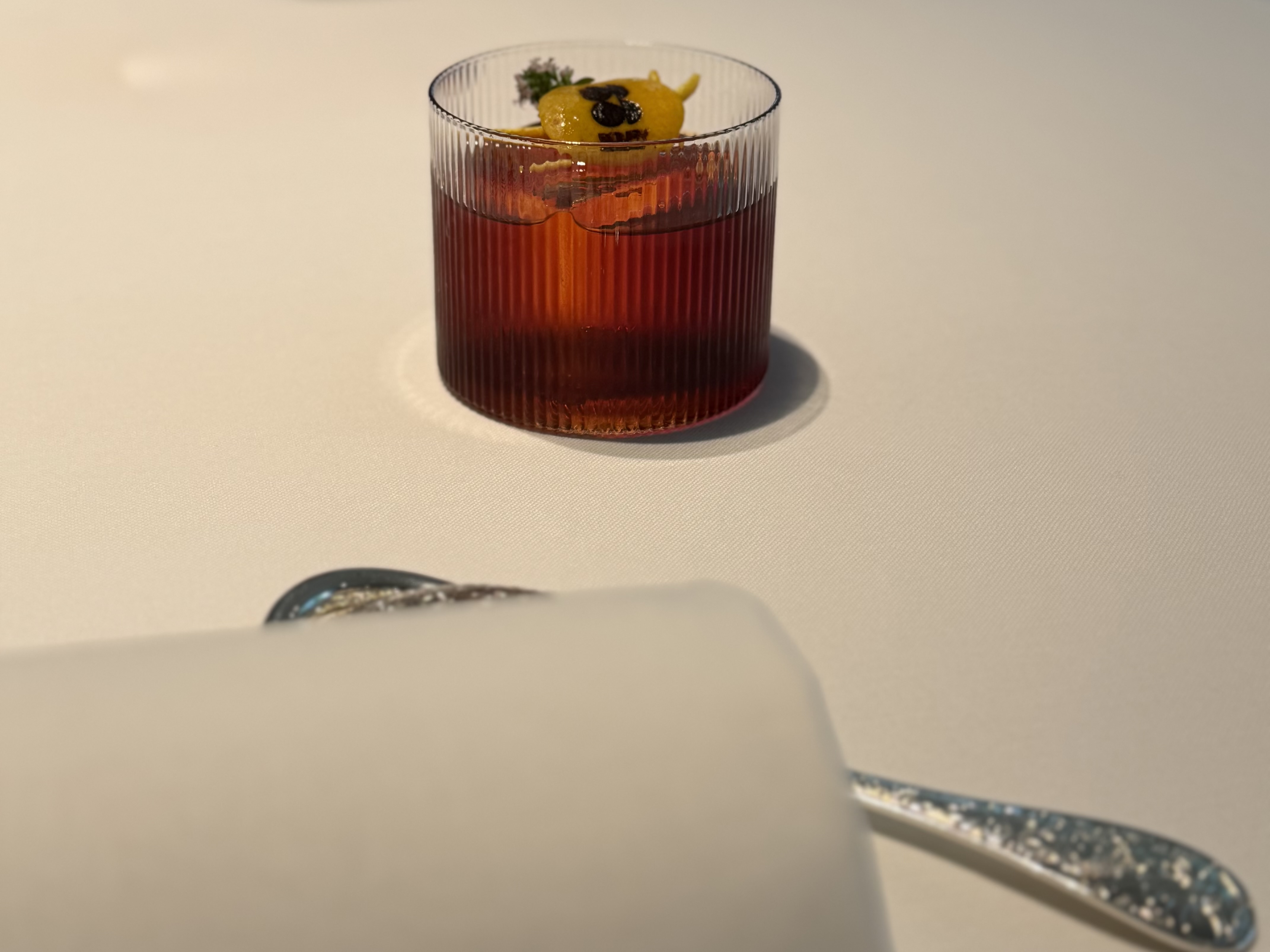
There are cocktails we order out of habit, and others we seek out because they might tell us something about the person who created them. The Negroni belongs to both categories. Its classical construction is universally recognisable, yet its apparent simplicity leaves nowhere for approximation to hide. Three ingredients, usually measured in equal parts, must find a common rhythm between alcohol, sweetness, aromatics and bitterness.
This is precisely what makes it such an interesting territory for chefs. When approached with the same attention given to a dish, the Negroni can move beyond the conventional aperitif to become a gastronomic creation in its own right. It can carry a landscape, a family memory, a method of production or a particular understanding of balance.
This search for the gastronomic Negroni is also at the heart of the Negroni Gang. The community travels, tastes and compares, not to establish a single definitive recipe, but to find Negronis with personality. Drinks that respect the cocktail’s foundations while expressing a place and the people behind it.
Three of these Negronis have left a particular impression: Emmanuel Renaut’s at Flocons de Sel in Megève, Alexandre Gauthier’s at La Grenouillère, and the Neroni created by Tim and Ben Boury at Restaurant Boury in Roeselare. Three cocktails conceived by chefs, three interpretations of bitterness, and three different ways of beginning a meal.

Emmanuel Renaut: the power of the mountain
At Flocons de Sel, Emmanuel Renaut’s cooking has always been inseparable from the mountain. The Alpine landscape is not treated as scenery or as an argument added to the experience. It provides an aromatic vocabulary, a rhythm and a way of observing ingredients.
The same principle can be found in his Negroni. Its foundation is Emmanuel Renaut’s own mountain gin, created from his work with plants, botanicals and distillation. Fir, juniper, roots, buds and high-altitude herbs become part of a spirit that carries the surrounding landscape without reducing it to an obvious image of the Alps.
Combined with vermouth and bitter from Maison Dolin in Chambéry, the gin gives the cocktail a strong regional coherence. The ingredients speak the same geographical language. More importantly, they create a Negroni that does not need an elaborate garnish or an explanatory discourse to establish its identity. The mountain is already inside the glass.
The blend is then aged in a barrel previously used for Château d’Yquem, adding depth and roundness while preserving the clarity of its bitterness. Emmanuel Renaut completes the recipe with a secret ingredient whose identity remains known only to him. This final gesture turns the cocktail into a true signature: a Negroni whose balance can be appreciated, but never entirely decoded or reproduced outside Flocons de Sel.
What immediately stands out is its power. This is a Negroni with structure, presence and aromatic intensity. Yet that power never becomes heaviness. The alcohol, bitterness and mountain botanicals remain remarkably balanced, each one reinforcing the others without taking complete control.
The aromatic profile develops gradually. Juniper provides the expected backbone of the gin, while the plants bring notes of forest, resin, roots and fresh vegetation. The vermouth creates volume, and the bitter gives the drink its length. There is a sense of density, but also a precision that prevents the cocktail from becoming demonstrative.
This balance between strength and aromatic complexity is what makes Emmanuel Renaut’s Negroni particularly gastronomic. It stimulates the palate rather than saturating it. It prepares the appetite while already creating a complete tasting experience.
Served at Flocons de Sel, it offers another way to enter the chef’s world before the first plate arrives. Instead of beginning with a glass of champagne, the guest begins with the mountain itself, transformed through distillation, bitterness and time.

Alexandre Gauthier: walnut wine, salt and memory
Alexandre Gauthier’s Negroni begins with another kind of territory. At La Grenouillère, the landscape is made of marshes, plants, wind, damp earth and the nearby Opal Coast. But the cocktail also reaches further back, into the history of the Gauthier family.
Its most distinctive ingredient is a family walnut wine, connected to Alexandre Gauthier’s grandfather and to a tradition passed down through the generations. This walnut wine is combined with gin and bitter before being finished with fleur de sel.
The ingredient immediately changes the usual profile of the Negroni. Walnut wine introduces a darker and more vinous dimension, with notes of green walnut, macerated fruit, spice and gentle oxidation. It gives the cocktail a sense of history, not through storytelling added afterwards, but through the recipe itself.
The originality is therefore not simply technical. It is emotional and gustatory. The cocktail contains a family memory while remaining entirely relevant to Alexandre Gauthier’s contemporary language. The past is not reproduced as an object of nostalgia. It is used as a living ingredient.
Then comes the fleur de sel, perhaps the most uncommon component of the recipe and one of its most important. Salt is often absent from the conventional vocabulary of cocktails, even though cooks understand its ability to transform the perception of every other flavour.
In this Negroni, the salt cuts through the sweetness created by the vermouth and walnut wine. It does not make the drink overtly salty. Instead, it restores movement, sharpens the structure and allows the bitterness to appear more clearly. The sweetness becomes less dominant, the walnut gains definition, and the finish becomes longer.
This is a cook’s gesture. Alexandre Gauthier does not simply add a new flavour to the Negroni. He seasons it. He treats the cocktail as a dish whose balance can be adjusted through a small but decisive intervention.
The association of walnut wine and fleur de sel creates a Negroni unlike any other. It is vinous, slightly oxidative, bitter, rounded and saline. Each sip seems to move between memory and precision, between the domestic tradition of a family recipe and the exactness of a contemporary restaurant.
The result is original without becoming eccentric. The classical identity of the Negroni remains perceptible, but its usual landmarks have shifted. The orange and herbal notes lead towards walnut, wine and salt, creating a cocktail that belongs specifically to La Grenouillère.
Here again, it can naturally replace a glass of champagne at the beginning of the meal. It creates a first connection with the chef’s universe and introduces one of the central ideas of Alexandre Gauthier’s cooking: taste is often transformed not by adding more, but by identifying the detail capable of changing the whole.

Tim and Ben Boury: precision served by the bottle
At Restaurant Boury in Roeselare, Tim and Ben Boury have developed the Neroni, their interpretation of the classic cocktail. The name already indicates a slight displacement, but the drink remains firmly connected to the original structure of gin, vermouth and bitter.
Its singularity lies in the construction of its components. The Boury brothers use products developed through their own Boury Bottled collection, including Sanguine Gin and Nero ’20 vermouth. The gin brings blood orange, pear, lemon verbena and juniper, while the vermouth is based on Nero d’Avola grapes and aged in Oloroso sherry barrels with Mediterranean herbs.
The Neroni is therefore conceived long before the ingredients enter the mixing glass. Its balance begins during the creation of the gin and vermouth themselves. Fruit, wine, botanicals, ageing and bitterness have already been considered as parts of the final cocktail.
This preparatory work is reflected in the tasting. The Neroni is remarkably precise. Sanguine Gin creates an immediate aromatic connection with the traditional Negroni. The vermouth brings depth, herbs and the oxidative character of Oloroso, while the amaro maintains the necessary bitter structure.
Many ingredients are present, but the drink remains readable. This is perhaps its most convincing quality. The Neroni never feels like a catalogue of technical ideas. Each element contributes to a controlled progression, from the freshness and fruit of the opening to the darker wine notes and bitterness of the finish.

Its service at Restaurant Boury adds another dimension. When ordered, the Neroni is brought to the table in its bottle. This presentation is not merely aesthetic. It changes the relationship with the cocktail.
The bottle introduces generosity and conviviality. The Negroni is no longer an individual drink delivered as a finished object and consumed in isolation. It becomes something that can remain on the table, be poured again and accompany the first moments of the meal.

This approach echoes one of the Negroni Gang’s most playful principles:
You never drink one Negroni. You always drink at least two.
The principle is less about quantity than about the nature of the moment. A Negroni should create time. It should encourage conversation, prolong the aperitif and allow the beginning of the meal to unfold without haste.
By serving the Neroni in a bottle, Restaurant Boury gives a practical and elegant answer to this idea. The second glass is already contained in the first gesture. The cocktail becomes more generous, more collective and more closely connected to hospitality.
This presentation also matches the spirit of the Boury experience. Precision is essential, but it never excludes pleasure. The technique remains controlled, while the bottle placed on the table introduces a sense of ease and abundance.

The Negroni as the first course of a meal
These three creations demonstrate that the Negroni can occupy a different position in a gastronomic restaurant. It does not have to remain an informal cocktail consumed before sitting down, nor does it need to compete with the menu that follows.
When properly balanced, it can become the first expression of the chef’s language. Emmanuel Renaut introduces the aromatic power of the mountain. Alexandre Gauthier brings together family memory, walnut wine and salinity. Tim and Ben Boury present a carefully constructed composition whose bottled service turns precision into generosity.
Each of these cocktails provides a genuine alternative to the traditional glass of champagne. Champagne brings freshness, acidity and ceremony. A gastronomic Negroni can offer another beginning: more bitter, more aromatic and sometimes more directly connected to the identity of the restaurant.
The choice is not necessarily between one and the other. It is about recognising that the aperitif can already be part of the culinary narrative. Before the amuse-bouche, before the menu and before the first explanation from the dining-room team, the cocktail can establish a tone.
At Flocons de Sel, La Grenouillère and Restaurant Boury, these Negronis perform that function with clarity. They awaken the palate, but they also create expectation. Their bitterness opens the appetite, while their respective identities provide a first indication of the meal to come.
The three drinks also reveal different relationships with the same classic. Emmanuel Renaut works through landscape and aromatic power. Alexandre Gauthier uses memory and seasoning. Tim and Ben Boury build the drink through the precision of its components and the conviviality of its service.

None of them attempts to erase the Negroni. On the contrary, each chef relies on the strength of its original structure. The cocktail remains recognisable because its bitterness, sweetness and botanical character are preserved. What changes is the perspective.
This is ultimately what the Negroni Gang seeks in every glass: not unnecessary reinvention, but a Negroni capable of belonging to someone and somewhere. A cocktail whose personality can be tasted before it needs to be explained.
These three Negronis achieve precisely that. They are not simply cocktails created by chefs. They are gastronomic Negronis, designed to be tasted at the table, capable of replacing the opening glass of champagne and already carrying part of the restaurant’s identity.
One comes from the mountain, one from a family walnut wine and a pinch of fleur de sel, and one arrives at the table in a bottle intended to extend the moment. Three signatures, three balances and three compelling stages in the Negroni Gang’s continuing search for the perfect Negroni.
Leave a Reply