
Some restaurant openings matter not only because of what happens at the table, but because of what they reveal about a city, a country and the direction in which hospitality is moving. Aldabaran Alain Ducasse belongs to this category. Installed on the 33rd floor of the Mohammed VI Tower, above Rabat, Salé, the Bouregreg valley and the Atlantic Ocean, the restaurant occupies one of the most symbolic places in contemporary Morocco.
Rising 250 metres above the capital, the Mohammed VI Tower is the tallest building in Morocco and one of the tallest on the African continent. Its silhouette has already transformed the skyline, but its meaning extends beyond architecture. Bringing together offices, residences, hospitality, wellness and gastronomy, it embodies a broader ambition: to position Rabat and Salé within the international landscape of luxury travel while giving this development a distinctly Moroccan identity.
Within this building, the opening of a restaurant bearing Alain Ducasse’s name could easily have become a simple display of prestige. Yet Aldabaran is more interesting when considered as a meeting point between several worlds: the Mediterranean culinary language of Ducasse, the international standards of the Waldorf Astoria, the craftsmanship of Morocco and the particular atmosphere of a capital that has long remained less exposed than Marrakech to the global hospitality industry.

Aldabaran takes its name from the brightest star in the constellation of Taurus. The reference naturally echoes the restaurant’s location, suspended above the city and surrounded by an almost uninterrupted horizon. Yet the address does not rely solely on the spectacle of its view. The dining room, the tableware, the service and the cuisine have all been designed to form a coherent experience rather than a succession of impressive elements.
The interior forms part of the broader vision developed by Pierre-Yves Rochon for the Waldorf Astoria Rabat Salé. Contemporary lines are combined with references to Moroccan craftsmanship through the use of metalwork, plaster, zellige and carefully selected materials. These elements are present without becoming demonstrative, allowing the restaurant to express its location without reducing Moroccan identity to decorative folklore.
This restraint is essential because the view could easily dominate everything else. From the dining room, Rabat, Salé, the river and the Atlantic unfold below the tables, constantly reminding the guest of the exceptional nature of the setting. Aldabaran nevertheless succeeds in ensuring that the architecture remains a frame rather than a substitute for the experience.

Aldabaran is not presented as a Moroccan restaurant, nor does it attempt to reproduce the country’s culinary repertoire. Its identity is clearly Mediterranean, drawing on the Riviera, southern France and the natural, product-focused cuisine that has long defined Alain Ducasse’s work. The connection with Morocco is therefore not constructed through artificial references or forced reinterpretations, but through a shared geographical and cultural language shaped by olive oil, vegetables, herbs, citrus fruits, seafood and the lightness of the Mediterranean table.
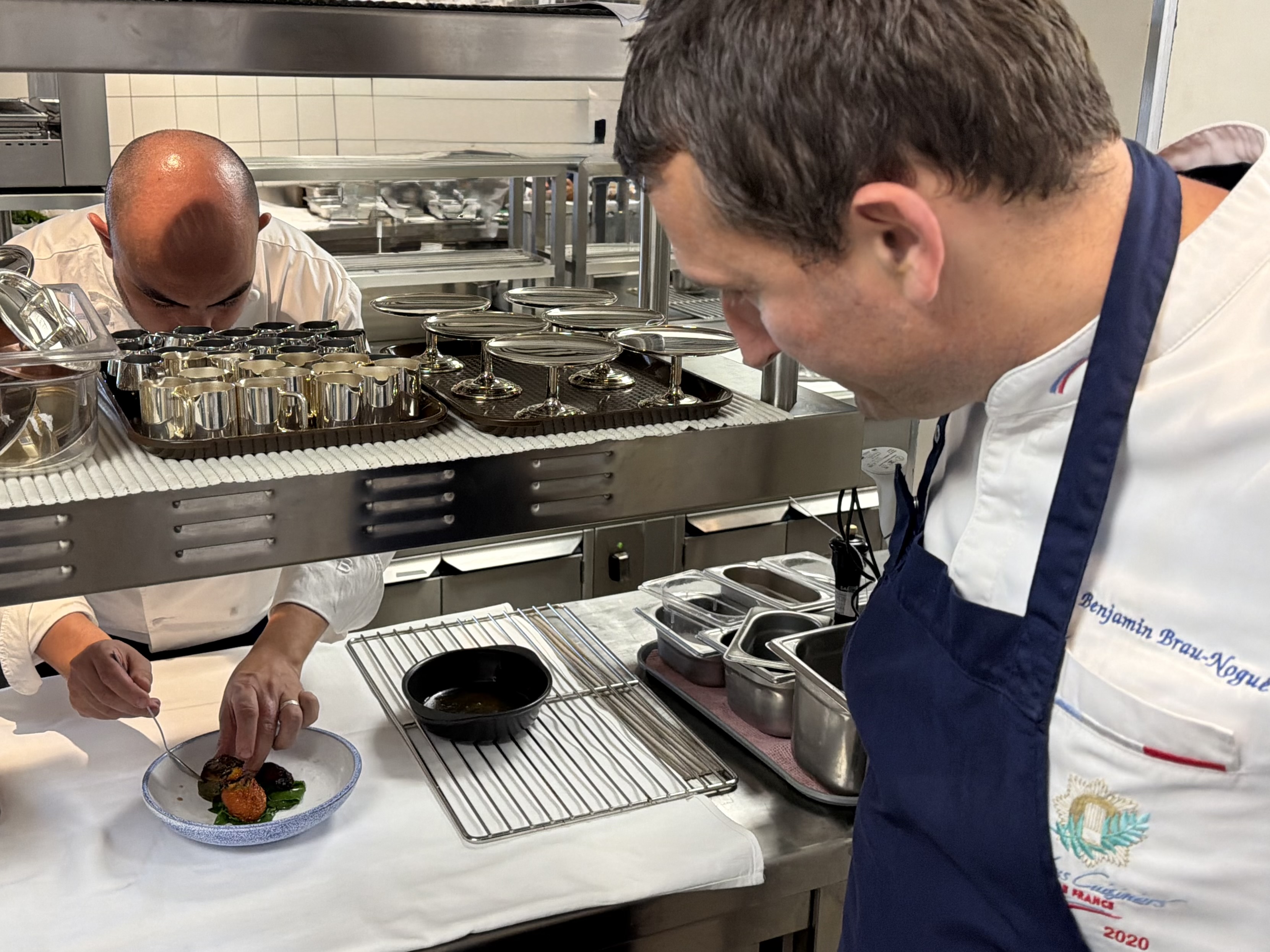
The kitchen is led on a daily basis by Morgan Perrigaud, who previously worked at JIWAN in Doha, alongside the hotel’s executive chef, Benjamin Brau-Nogué. Their responsibility is considerable because the success of such a restaurant depends on its ability to translate an international signature into a living, consistent experience. Rather than merely reproducing a catalogue of Ducasse dishes, the team must give the restaurant its own rhythm while respecting the clarity, precision and apparent simplicity associated with the chef’s universe.
The cuisine is built around excellent products, exact cooking and sauces that provide depth without creating unnecessary heaviness. It avoids the accumulation of effects and allows the main ingredient to remain immediately identifiable. This sense of clarity is one of the strongest qualities of the meal, as each plate appears controlled without feeling rigid and refined without losing the pleasure that should remain at the centre of any gastronomic experience.

The menu tasted during this first visit included :
- Pissaladière, pâte à pain, compotée d’oignons, olives taggiasche et anchois
- Panisses à l’huile d’olive; Crevettes grillées puis rafraîchies, condiment des têtes
- Mulet de pleine mer mariné, marmelade d’agrumes, granité d’herbes fraîches
- Araignée de mer, concombre et caviar Kristal; Petits farcis façon Lucien Tendret
- Bar de ligne aux artichauts, jus d’une barigoule; Agneau, caponata et sarriette
- Citron de l’Agrumiste, fleur d’oranger; Baba au rhum, vanille et agrumes
- Soufflé au chocolat de la Manufacture Alain Ducasse
- Affogato à notre façon.
Read as a whole, the menu expresses a cuisine travelling between the French Riviera, Italy and the broader Mediterranean basin. The pissaladière, panisses, petits farcis and barigoule establish a clear southern French foundation, while caponata, olive oil, citrus fruits and aromatic herbs extend this geography beyond national borders. Seafood occupies an important place, giving the meal a marine line that feels particularly appropriate in a dining room overlooking the Atlantic.
The products are undeniably luxurious, and the restaurant does not pretend otherwise. Spider crab, caviar, line-caught sea bass and carefully selected citrus fruits belong to a proposition aimed at an international clientele accustomed to the standards of major luxury hotels. Yet these ingredients are not presented as symbols in themselves. Their value comes from the precision with which they are prepared and from a cuisine that generally resists the temptation to overstate their importance.

The most convincing aspect of Aldabaran lies in the way the Ducasse identity appears without becoming a form of repetition. The cuisine remains instantly recognisable through its attachment to the product, its Mediterranean references and its search for lightness, but it does not feel frozen inside a predetermined model. The work of Morgan Perrigaud and Benjamin Brau-Nogué gives the restaurant enough autonomy to exist in Rabat rather than appearing as a distant extension of Paris or Monaco.
This balance is particularly important for a restaurant carrying such a name. The Alain Ducasse signature creates immediate expectations, but it can also become a burden when the restaurant relies too heavily on reputation. At Aldabaran, the name opens the door, while the local team is responsible for ensuring that the experience remains credible once the guest is seated.
The meal demonstrates a strong command of sauces, marinades, condiments and temperatures, but the technical dimension is rarely placed in the foreground. The cuisine does not require lengthy explanations in order to be understood, and the plates remain readable despite the level of work involved. This is perhaps the clearest expression of mastery: complexity is present, but it has already been resolved before reaching the table.

The restaurant’s coherence also depends on everything surrounding the cuisine. Silverware, ceramics, fabrics, lighting and service are treated as part of the same narrative, creating an environment in which luxury is expressed through consistency rather than accumulation. The references to Moroccan craftsmanship are integrated into this experience with enough restraint to avoid becoming a theme imposed on the guest.
Despite the recent opening, the dining room team already demonstrates a high level of attention. The service understands the codes of an international luxury hotel while retaining a sense of natural hospitality. It accompanies the meal without turning every gesture into a performance, which is particularly important in a setting where formality could easily become excessive.
The sommellerie follows the same approach. The wines are expected to support the Mediterranean character of the cuisine, bringing freshness, structure and depth without competing with the plates. More broadly, the restaurant succeeds when every element, from the first welcome to the final coffee, appears to belong to the same level of intention.
This experience naturally comes at a price. A three-course lunch costs around one hundred euros, which clearly places Aldabaran outside the reach of a broad local audience. The restaurant belongs to the international luxury market and should be judged within that context. The question is therefore not whether the price is high, but whether the quality of the products, the setting, the service and the overall execution are sufficiently coherent to justify it. During this first visit, the answer was largely positive.

The opening of Aldabaran should also be understood within the wider development of the Moroccan hotel and restaurant landscape. For many international travellers, luxury tourism in Morocco has long been associated primarily with Marrakech. Rabat is now constructing a different proposition, based on culture, architecture, institutions, diplomacy and a more understated form of hospitality.
The Waldorf Astoria Rabat Salé contributes directly to this transformation. With 55 rooms and suites, several dining spaces, a spa and an important art collection, the hotel is designed as a destination in itself. Aldabaran occupies a central position within that project because gastronomy has become one of the clearest ways for major hotels to establish an identity beyond accommodation.
The presence of Alain Ducasse in Rabat is therefore not an isolated announcement. It reflects the growing confidence of Morocco’s luxury sector and its desire to attract an international clientele through experiences capable of competing with those offered in other major capitals. It also gives Rabat a gastronomic address whose visibility extends well beyond the city.

The restaurant will, of course, need to be observed over time. The real test will be its ability to maintain the level of service, develop the personality of its resident kitchen team, strengthen its relationship with Moroccan producers and find a place within the local dining landscape rather than remaining solely a destination for hotel guests and international visitors.
For now, Aldabaran offers a convincing first expression of what this project can become. The cuisine is precise and controlled, the experience is coherent, and the setting possesses a power that the restaurant has not allowed to overwhelm the table. At the 33rd floor of the Mohammed VI Tower, Alain Ducasse’s first Moroccan address does not merely look out over Rabat. It accompanies a city and a country that are increasingly looking towards the horizon.

Leave a Reply