
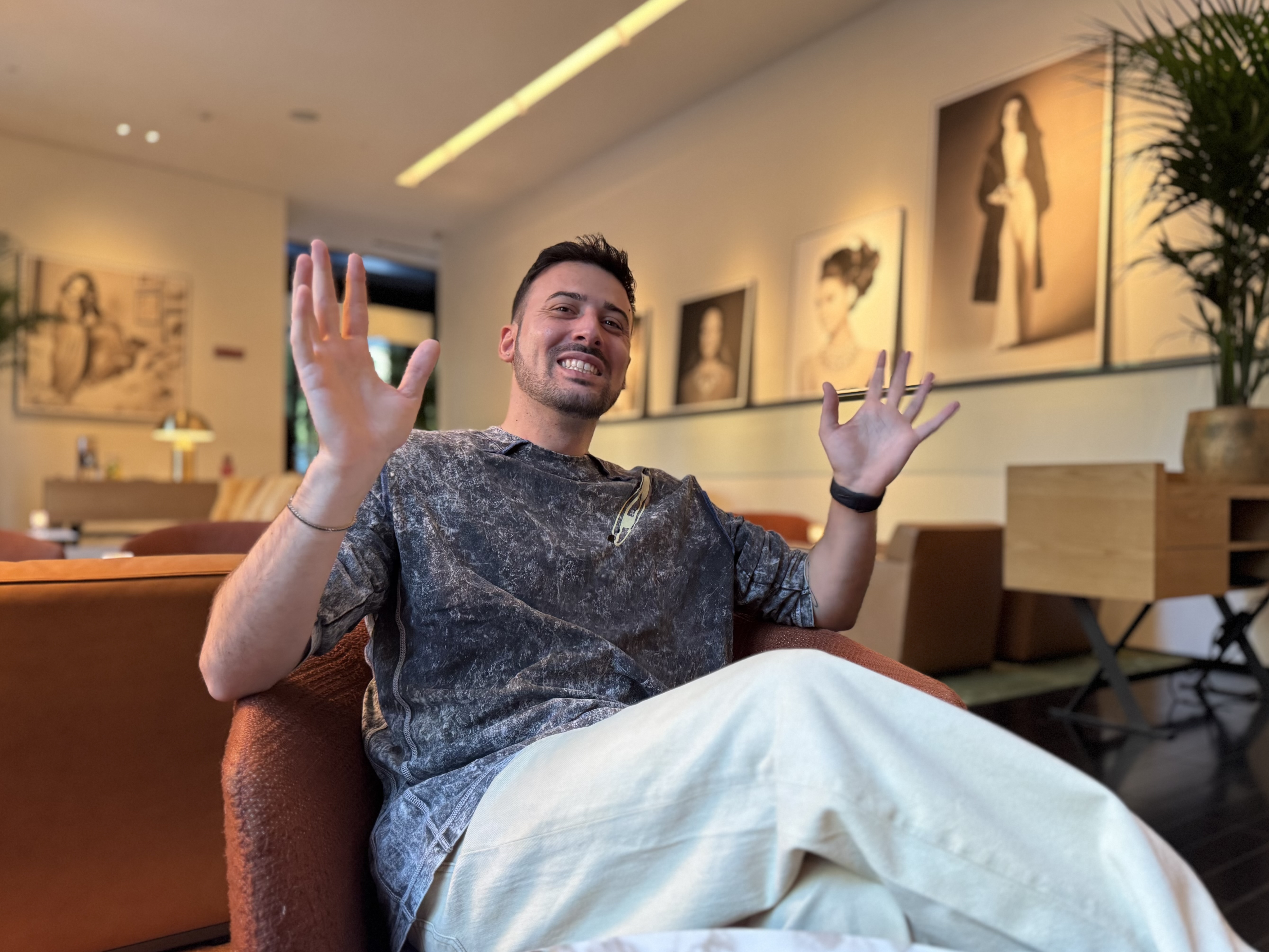
Mirko Febbrile speaks about cooking as someone who has never accepted the idea that a chef should be defined by a single discipline. Food, design, fashion, hospitality and entrepreneurship belong to the same landscape in his mind. They influence one another before eventually finding their place in the restaurant.
“I feel that I am an atypical chef,” Mirko Febbrile
His story begins in Puglia, inside the small family shop where he grew up. Food was part of daily life and was linked to resourcefulness, work and the ability to create something meaningful from what was available. His mother gave him a definition of cooking that has remained with him ever since:
“A good chef, can make the best lunch with the two onions that are left in the refrigerator.”
The sentence contained no reference to luxury ingredients or technical display. It expressed a way of looking at the world.
Mirko Febbrile began cooking at the age of twelve. Curiously, his first fascination was pastry, which he discovered through the internet rather than through a professional kitchen. Pastry appealed to him because it imposed precision. Ingredients had to be weighed, temperatures respected and gestures repeated until the expected result appeared.
“With pastry, everything needs to be precise,” Mirko Febbrile
This discipline offered him an initial structure, even though his personality would eventually push him towards a more instinctive and expansive understanding of cuisine.
Before entering gastronomy fully, Mirko Febbrile also considered interior design and that interest never disappeared; it simply changed its field of application. Today, he does not separate the composition of a plate from the architecture surrounding it. The same questions return in different forms: how does a guest move through a space, where does the eye settle, how does an object create anticipation, and how can a detail alter the perception of the whole? Cooking became the central language through which his other interests could continue to exist.
His early professional experiences were not confined to prestigious restaurants. He also worked at McDonald’s, an episode that sits naturally within his account rather than being treated as an embarrassing detour. It exposed him to speed, repetition, systems and the practical organisation required to serve large numbers of people. Haute cuisine would later give him other tools, but this first contact with a highly codified operation introduced a reality that chefs sometimes prefer to ignore: a restaurant also depends on consistency, logistics and a model that can function every day.
Singapore was Mirko Febbrile’s first major travel away from Italy. It placed him in a city where cultures, ingredients and culinary expectations continuously overlap. After an initial experience at the National Gallery, he joined Braci, an intimate restaurant with around fifteen seats organised around a charcoal grill. The cuisine combined an Italian foundation with products drawn extensively from Japan. It was a compact setting in which every decision remained visible, leaving little room for approximation.
Within six months, Braci received a Michelin star. Mirko Febbrile was twenty-four.
“In six months, we had a Michelin star. I was twenty-four years old,” he recalls.
The distinction arrived early, before he had fully understood what leadership required. Technical competence and personal endurance had carried him forward, but managing others demanded something different.
“I was not a leader yet. I was working with the values my family had given me.” Mirko Febbrile
Those values allowed him to hold the kitchen together, although he now recognises that responsibility cannot rely on instinct alone.
The star brought recognition, but it also confronted him with the fear of failing after success had arrived. Febbrile does not romanticise this pressure. He speaks openly about the difference between obtaining a result and becoming capable of sustaining it. The experience forced him to examine not only what he wanted to cook, but the kind of chef and employer he wanted to become. Culinary ambition could no longer remain an individual matter. It had consequences for everyone working around him.
Somma emerged from that evolution. The restaurant represents a far greater share of his own choices, from the menu to the design and the structure of the experience. Its name evokes an addition, a sum of influences rather than the defence of a fixed identity. Puglia remains present, but Mirko Febbrile does not use it as a catalogue of traditional dishes. It appears through gestures, memories, combinations and an understanding of generosity that has travelled with him.
This distinction matters. His food is Puglian because of the way he thinks, not because every plate must reproduce a recognisable regional recipe. The distance from Italy has encouraged him to identify what is essential and what is merely decorative. He sources the large majority of his ingredients from Europe, yet provenance alone is never enough to justify their presence. A product must belong to the language of Somma and to his own appetite.
“I do not want to cook something that I would not like to eat,” Mirko Febbrile
That principle also explains certain refusals. “Foie gras will never arrive at Somma,” he states, not because he questions its status as a luxury ingredient, but because it does not express what he wants the restaurant to become. Mirko Febbrile is less interested in assembling conventional signs of prestige than in developing a coherent vocabulary. An ingredient cannot enter the menu simply because guests associate it with fine dining. It must contribute to the restaurant’s identity.
The same requirement applies to the dishes themselves.
“It is not enough for it to be good. It has to be unique.”
The phrase captures both his ambition and his dissatisfaction with cuisine that limits itself to correct execution. Technique remains indispensable, but technical success is only the beginning. A dish should carry a point of view that could not easily be transferred to another chef or another restaurant. Uniqueness, in this sense, does not mean eccentricity. It means that every decision should reveal who made it.
Mirko Febbrile is equally direct about Michelin. Having received a star early in his career, he refuses to make its recovery the organising principle of Somma. “I do not care about the Michelin star. I already had it,” he says. The statement is not a rejection of recognition. It is a refusal to design a restaurant backwards, beginning with what an inspector might expect and then constructing the experience accordingly. The restaurant must first be faithful to its own intentions.
At Somma, those intentions extend beyond the plate. Mirko Febbrile compares a restaurant to a fashion show, where a collection is understood through its rhythm, staging, silhouettes, materials and progression.
“For me, a restaurant is like a fashion show.” Mirko Febbrile
Each plate forms part of a sequence, but so do the furniture, uniforms, music, lighting and service. No single element can explain the experience on its own. Meaning appears through their accumulation.
The building itself contributes to this narrative. Somma occupies a space that once housed a school library, a past that gives the restaurant a particular sense of order and concentration. Mirko Febbrile uses the architecture to create a separation from the city outside.
“I want people to forget that they are in Singapore,” Mirko Febbrile
The ambition is not to imitate Italy, but to create a temporary world with its own tempo and emotional geography.
Despite the precision of this construction, comfort remains central. “I want people to feel at home.” The apparent contradiction between control and intimacy is deliberate. Mirko Febbrile wants the restaurant to be carefully directed without making guests feel that they are moving through a rigid ceremony. Luxury, in his view, appears when complexity has been absorbed by the organisation and no longer needs to be demonstrated at the table. Guests should experience attention rather than effort.
This approach has also altered his understanding of business. Mirko Febbrile readily describes himself as both a chef and a businessman. He sees no opposition between creativity and economic structure, provided that one does not erase the other. “Success in the restaurant business is the balance between the vision, the people and the business model.” A strong concept without a sustainable organisation eventually exhausts the team. A profitable restaurant without a clear identity eventually becomes indistinguishable from others.
Leadership forms the most personal part of this balance. Mirko Febbrile admits that he never had a single mentor who accompanied him through every stage of his career. He learned through fragments: from his family, from colleagues, from mistakes and from the responsibilities he was given before feeling entirely ready for them. “I never had a mentor,” he says. The absence has made him conscious of what younger cooks may need when they enter his kitchens.
He rejects the familiar image of the chef whose authority depends on distance or fear. “I do not like being a stereotypical chef.” For Mirko Febbrile, leadership now involves accepting responsibility instead of transferring blame down the hierarchy. When something fails, he questions the system and the instructions before accusing the person who executed them. “Why put someone else under the bus?” he asks. The expression reveals a change from the young chef who relied primarily on endurance to the employer who understands that an organisation reflects the behaviour encouraged at its centre.
This responsibility also determines how he speaks to his team. “I want people to look me in the eyes.” The sentence is not about submission. It describes the directness he expects in a working relationship: the ability to disagree, to ask questions and to recognise the person behind the position. Kitchens often claim to function like families while preserving structures in which honest dialogue remains impossible. Mirko Febbrile appears more interested in building trust through clarity than in using the language of family as a substitute for management.
He is equally aware that his own trajectory depended on someone deciding to take a chance on him. “Someone created an opportunity for me. I want to return what I received.” Transmission therefore becomes practical. It involves giving responsibility, allowing people to grow and accepting that a young cook cannot demonstrate potential without first being offered a space in which to do so. The chef’s role is not only to protect a standard, but to create the conditions through which others may eventually surpass it.
Mirko Febbrile describes change in similar terms. “Change is an opportunity and a responsibility.” His move from Puglia to Singapore, the transition from pastry to savoury cooking, the Michelin star at twenty-four and the creation of Somma all required him to abandon a previous version of himself. Yet the geography of his childhood has never disappeared. It remains in the lesson of the two onions, in his resistance to unnecessary display and in his belief that creativity begins with attention rather than abundance.
Mirko Febbrile’s inner geography is not a map leading back to one place. It is the territory formed by everything he has chosen to carry forward. At Somma, identity does not appear as nostalgia. It becomes a method: selecting what matters, removing what feels borrowed and ensuring that every part of the restaurant belongs to the same intention.
Leave a Reply