
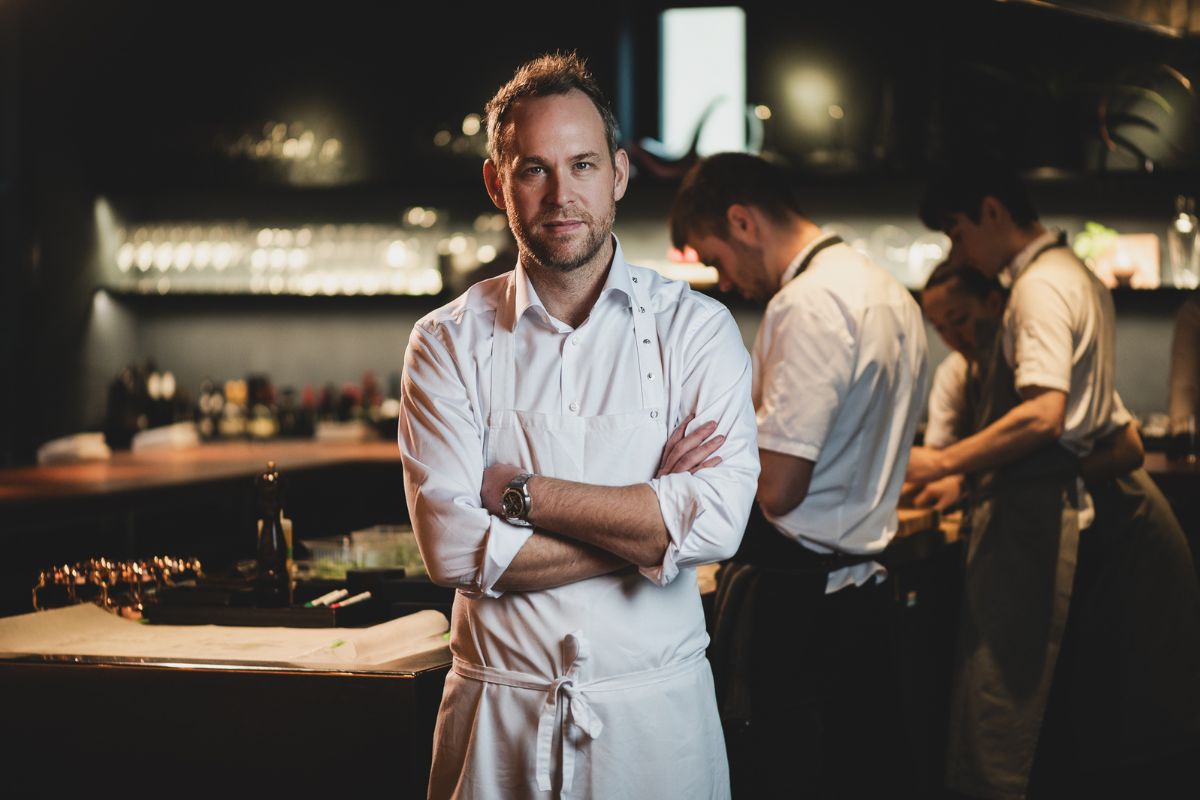
Björn Frantzén is preparing to bring two distinct expressions of his cuisine to Australia. In 2027, the Swedish chef will open Én by Björn Frantzén at Crown Sydney and Brasserie Astoria at Crown Perth. The two restaurants will share the same culinary foundation, but they will not offer the same experience. One will extend the chef’s fine-dining language and the other will translate it into the freer rhythm of a contemporary brasserie.
The announcement marks a new stage in the international development of the Frantzén Group. Björn Frantzén currently oversees three restaurants awarded three Michelin stars: Frantzén in Stockholm, Zén in Singapore and FZN in Dubai. This makes him the only chef currently associated with three restaurants holding Michelin’s highest distinction simultaneously, across three different countries.
His progression has been built through expansion without simple reproduction. Björn Frantzén became Sweden’s first three-Michelin-starred restaurant in 2018, after moving from a small dining room in Stockholm’s old town into a nineteenth-century townhouse arranged across several floors. Zén later adapted part of that experience to a Singaporean shophouse, while FZN introduced the same pursuit of precision to Dubai. Each restaurant carries the chef’s identity, but each has been shaped by its city rather than conceived as a direct copy of Stockholm.
Australia will now receive that philosophy through two formats. Scheduled to open in mid-2027, Én will occupy level 26 of Crown Sydney, overlooking Sydney Harbour. Although the complete menu and structure have not yet been disclosed, the restaurant is being presented as the more ambitious of the two projects, with a fine-dining experience connected to the chef’s established combination of Nordic foundations, Japanese influences and French technique.
That combination has long defined Frantzén’s cooking. Nordic ingredients and methods provide the initial structure, but the cuisine moves freely through Japanese products, French sauces and international luxury ingredients. The result is not organised around geographical purity. It depends instead on the balance between flavour, temperature, texture and service, with each course forming part of an experience that often unfolds through several rooms and different moments at the table.
The name Én, meaning “one” in Swedish, also gives the Sydney restaurant a particular responsibility. It suggests a singular destination rather than a secondary version of an existing address. Positioned high above Barangaroo, the restaurant will have to find its own relationship with Sydney, its produce and the expectations of a city already familiar with international chefs operating inside luxury hotels.
In Perth, Brasserie Astoria will offer a different reading of the Frantzén universe. The restaurant will open within Crown Towers in a new space that has not yet been revealed publicly. It is expected to follow the more relaxed, à la carte format introduced by the original Brasserie Astoria in Stockholm, where the group moved beyond the fixed progression of a tasting menu without abandoning its attention to ingredients, preparation and service.
Brasserie Astoria first appeared in Stockholm in 2021, inside a former cinema associated with the city’s social life of the 1920s and 1930s. The concept was designed around the energy of the traditional grand brasserie, but without treating the format as a historical reconstruction. Oysters, tartare, whole fish, duck, pasta and dishes finished in the dining room sit within an atmosphere shaped as much by movement and hospitality as by culinary technique.
This distinction between the two Australian restaurants is essential. Én will ask guests to enter a controlled sequence devised around a complete experience. Brasserie Astoria will allow them to choose, return, share and construct the meal more freely. The cooking may originate from the same chef, but the relationship with the diner will be different.
Frantzén has said that Australia had remained on his radar because of its produce and food culture. That interest will now be tested on opposite sides of the country, between Sydney’s established fine-dining market and Perth’s increasingly confident restaurant scene. The challenge will not be simply to introduce a successful international name, but to determine how Australian ingredients can enter a culinary language developed across Stockholm, Singapore and Dubai.
The decision to open both restaurants within Crown also places the projects within a wider movement in Australian hospitality. International chefs are no longer being invited only for temporary dinners or short residencies. They are being asked to create permanent destinations capable of changing the identity of an entire hotel or dining precinct. In Sydney, Én will join a portfolio that already includes Nobu, a’Mare, Woodcut and Golden Century, while Brasserie Astoria will enter a Perth collection featuring Nobu, Rockpool Bar & Grill, Silks and Yarri.
Much remains unknown, including the chefs who will lead the kitchens, the exact menus and the degree to which local products will reshape each concept. Yet the intention is already clear. Björn Frantzén is not coming to Australia with one restaurant reproduced twice. He is arriving with two ways of presenting his work: one built around the concentration of fine dining, the other around the openness of a brasserie.
When Én and Brasserie Astoria open in 2027, Sydney and Perth will not simply welcome another celebrated European chef. They will receive two different interpretations of the same culinary philosophy, separated by format, city and rhythm. The interest will lie in seeing how Frantzén preserves the precision that made his name while allowing Australia to change the way that name is expressed.
Leave a Reply