
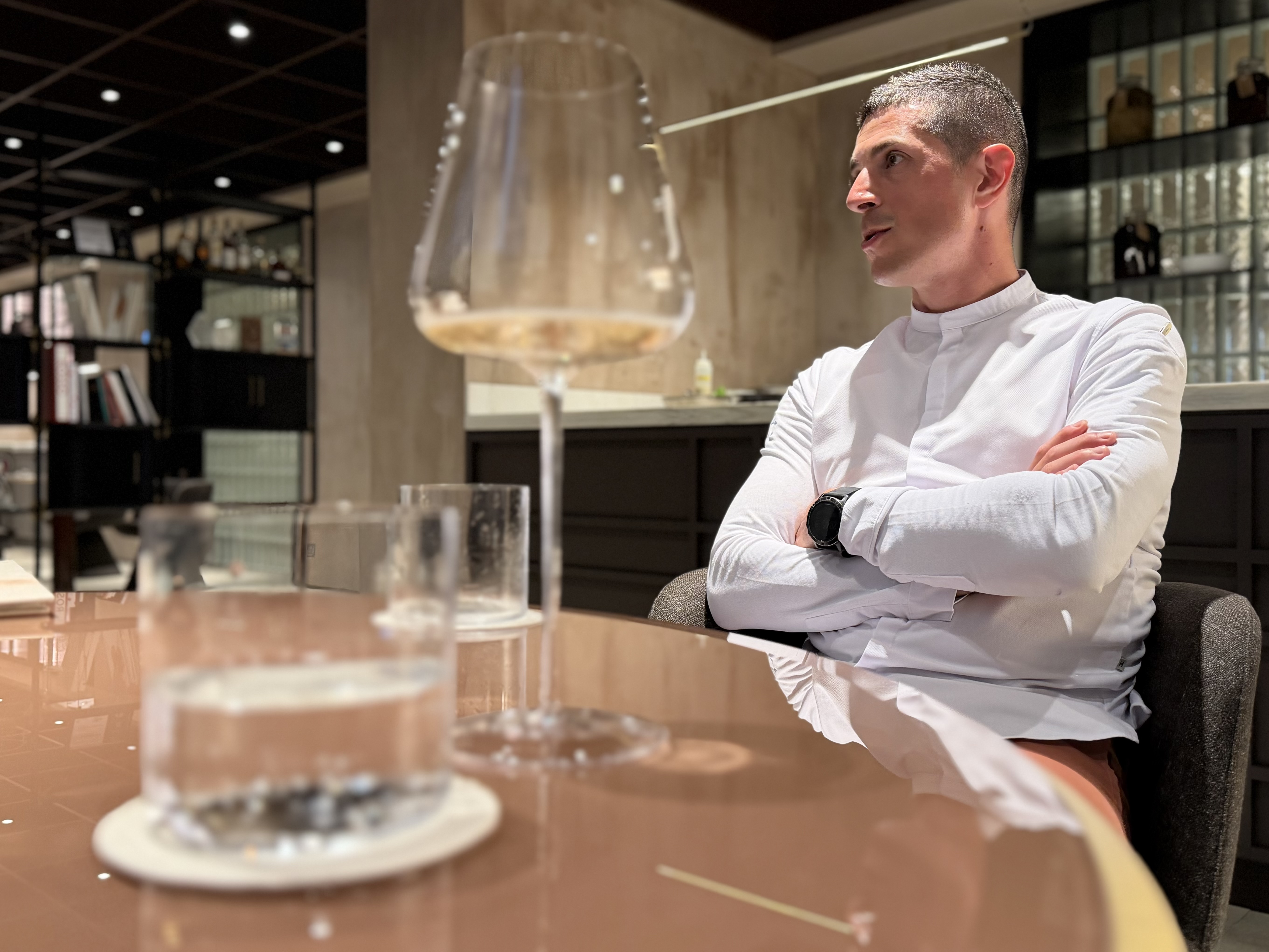
Facing the hills of Serralunga d’Alba, in the heart of the Langhe, La Rei Natura has been conceived as a continuous journey in which cuisine, service, architecture and landscape share the same direction. The experience is there not confined to a dining room or reduced to a succession of courses. It unfolds through different spaces and atmospheres, allowing each stage of the meal to find its own rhythm while gradually revealing the world of Michelangelo Mammoliti.
At forty, the Piedmontese chef of Calabrian heritage has established himself as one of the defining figures of his generation. After receiving his first Michelin star in 2017 and his second three years later, he joined La Rei Natura in 2022 and reached the highest distinction with the 2026 Michelin Guide, announced at the end of 2025. The achievement confirms the maturity of a cuisine in which considerable technical precision is accompanied by something less easily measured: the ability to turn a flavour into an emotion, a landscape into an idea and a personal memory into an experience that can be shared.

The restaurant, designed by interior architect Stefano Guidotti from an original vision by Michelangelo Mammoliti, extends the chef’s understanding of service beyond the conventional boundaries between kitchen and dining room. The experience is divided into three main spaces corresponding to the principal movements of the meal, from the opening snacks and aperitif to the main tasting sequence and, finally, the world of pastry.

This progression gives the restaurant an unusual fluidity. The guest does not simply receive the dishes but follows their development, while members of the brigade complete certain preparations at dedicated stations in full view of the room. The chefs become visible participants in the experience, without allowing their presence to turn into an unnecessary performance. Their gestures provide continuity between the kitchen and the table, making service part of the culinary process itself.
The interiors translate this philosophy through materials chosen for their connection to the natural world. Raw-earth walls bring depth and texture, while terracotta tiles are laid across the floor like a network of Roman roads. Fabrics, curtains, resins and metals introduce restrained but clearly defined colours, creating rooms that feel rooted in their surroundings without attempting to reproduce the landscape literally.
“The natural element is fundamental in the creation of a recipe, and I wanted this approach to continue throughout the restaurant, with rooms that speak of nature without having to explain anything. Everything is simply before your eyes,” Mammoliti explains. This principle is visible not only in the interior design but also in the relationship between the restaurant and its kitchen gardens and greenhouses, where the chef and his team cultivate herbs, spices, roots, flowers and vegetables according to biodynamic principles.

Michelangelo Mammoliti defines his cuisine through three ideas: nature, memory and instinct. Each has a distinct place in his work, yet none exists independently from the others. Nature determines the available ingredients and their moment of use, memory gives the dishes an emotional foundation, while instinct allows the chef to move beyond the expected boundaries of Piedmontese or Italian cooking.
The Langhe remain central to his thinking, but they are never treated as a limit. Mammoliti draws on his Piedmontese upbringing and Calabrian family heritage while incorporating the techniques, spices and flavours encountered during fifteen years of travel and professional experience. His time in France taught him how to lead a kitchen and helped shape the discipline behind his cooking, but his language now belongs entirely to him.
This freedom can be found in the structure of the restaurant’s three tasting menus. De Rerum, composed of ten courses, presents the most complete and current expression of the chef’s vision. MAD100%Natura® places the plant world at the centre of the experience, with animal protein used discreetly to support its intensity. Voyage follows the international influences and encounters that have shaped Mammoliti’s cuisine, embracing more distant flavours without turning them into a catalogue of destinations.

These menus reveal different aspects of the same identity rather than separate culinary styles. Whether the point of departure is a vegetable grown in the restaurant’s greenhouse, a family memory or a technique discovered abroad, the dish must eventually become personal. The reference may remain visible, but it is absorbed into a language that belongs to La Rei Natura.
The meal tasted during our visit brought together ten dishes, each carrying its own name and identity:
- RHABARBARUM SAMBUCO – Roasted langoustine glazed with rhubarb molasses, Urfa biber and a brunoise of peas with elderflower
- PISSALADIÈRE – Tropea onion roasted in the spirit of a Provençal pissaladière
- NOLCHE – Purple prawn from Sanremo
- CUBIX – Ravioli filled with yakitori-grilled eel, rocket infusion
- MONTANO – Spaghetti cooked in an extraction of mountain herbs and cypress
- BBQ – Spaghetti cooked in an extraction of barbecued ham
- VALENCIA – Red mullet fillet, Valencian sauce
- KERALÀ – Sweetbread glazed with Kerala pepper, inspired by steak au poivre
- NÈFLE – Loquat treated like a peach with amaretto
- VICTORIA – Victoria pineapple charcuterie, ember sorbet and Tahitian vanilla

The sequence shows how freely Michelangelo Mammoliti moves between territories, culinary traditions and personal recollections. A Tropea onion becomes the centre of a Provençal pissaladière, while the Italian tradition of filled pasta meets the memory of Japanese yakitori in CUBIX. The reference is never used as a destination in itself. It provides the starting point from which the chef can construct something that belongs to his own history.
This is particularly clear in the two spaghetti courses, which begin with the same familiar form but move in very different directions. MONTANO draws its identity from the landscape, cooking the pasta in an extraction of mountain herbs and cypress. BBQ, meanwhile, returns to the memory of family grills through an extraction of barbecued ham, transforming a familiar childhood flavour into a concentrated and technically precise dish.


Placed together, the two plates reveal the breadth of Michelangelo Mammoliti’s approach. One looks outward and attempts to capture the scent of a place, while the other looks inward and reconstructs a personal memory. Both demonstrate his ability to use technique without making it the subject of the dish. The work may be complex, but what reaches the guest remains direct and immediately expressive.
The journey continues through VALENCIA, where red mullet meets the idea of a Valencian sauce, and KERALÀ, which reinterprets the generosity of a classic steak au poivre through sweetbread and Kerala pepper. These dishes are not presented as exercises in fusion. They show a chef comfortable enough with his own identity to invite distant influences into his cuisine without losing its coherence.

The technical command behind the menu is evident, yet it rarely asks to be admired for its own sake. Cooking, extraction, fermentation, concentration and transformation are used to clarify the intention of each dish rather than to prove the ability of the kitchen. Mammoliti does not remove the character of an ingredient in order to demonstrate what can be done with it; he changes its perspective while preserving the flavour that made it interesting in the first place.

This approach extends to the final courses. NÈFLE takes the memory of a peach with amaretto and transfers it to loquat, while VICTORIA treats pineapple according to the visual and technical codes of charcuterie before bringing together smoke, embers and Tahitian vanilla. The transition towards sweetness therefore continues the language established throughout the meal instead of interrupting it with a separate pastry demonstration.
What emerges is a cuisine of considerable individuality, capable of moving from a vegetable garden in the Langhe to Provence, Japan, Valencia or Kerala without appearing dispersed. Every course opens a different door, but the same chef remains behind each one. The unity of the meal does not come from repetition or from the systematic use of a recognisable signature; it comes from the consistency of Mammoliti’s point of view.

The final part of the experience takes place in a room dedicated to pastry, where chefs prepare the desserts and petits fours in front of the guests. This change of setting gives the sweet conclusion its own identity and prevents it from becoming a simple extension of the main dining sequence. The mise en place begins again, the perspective changes and the rhythm becomes more intimate, while the principles governing the restaurant remain unchanged.
Giving pastry a physical space of its own also reveals the importance Mammoliti places on the conclusion of a meal. Dessert is not treated as the moment when attention begins to fade, but as a new chapter with its own gestures and atmosphere. The guest encounters another part of the brigade and another expression of the same philosophy, creating the impression that the journey is beginning again just as it appears to be ending.

La Rei Natura offers a rare example of a restaurant in which every component appears to have developed from the same original thought. The architecture does not attempt to compensate for the cooking, the service does not compete with it and the landscape is never reduced to a decorative argument. Each element contributes to the experience while preserving its own function.
The third Michelin star recognises the level of the cuisine, but the significance of La Rei Natura lies equally in the completeness of the chef’s vision. Mammoliti has created a restaurant that reflects his relationship with nature, his family memories, his years of travel and the discipline acquired throughout his career. These influences coexist without weakening one another because they have been transformed into a language that now feels entirely his own.

Facing the vineyards and hills of Serralunga d’Alba, La Rei Natura confirms Michelangelo Mammoliti’s place among the leading figures of European gastronomy. His cooking is ambitious without becoming demonstrative, emotional without falling into nostalgia and rooted in Piedmont without allowing geography to restrict its movement. In a restaurant where the guest travels from one room to another, the most compelling journey remains the one taking place on the plate.

Leave a Reply