
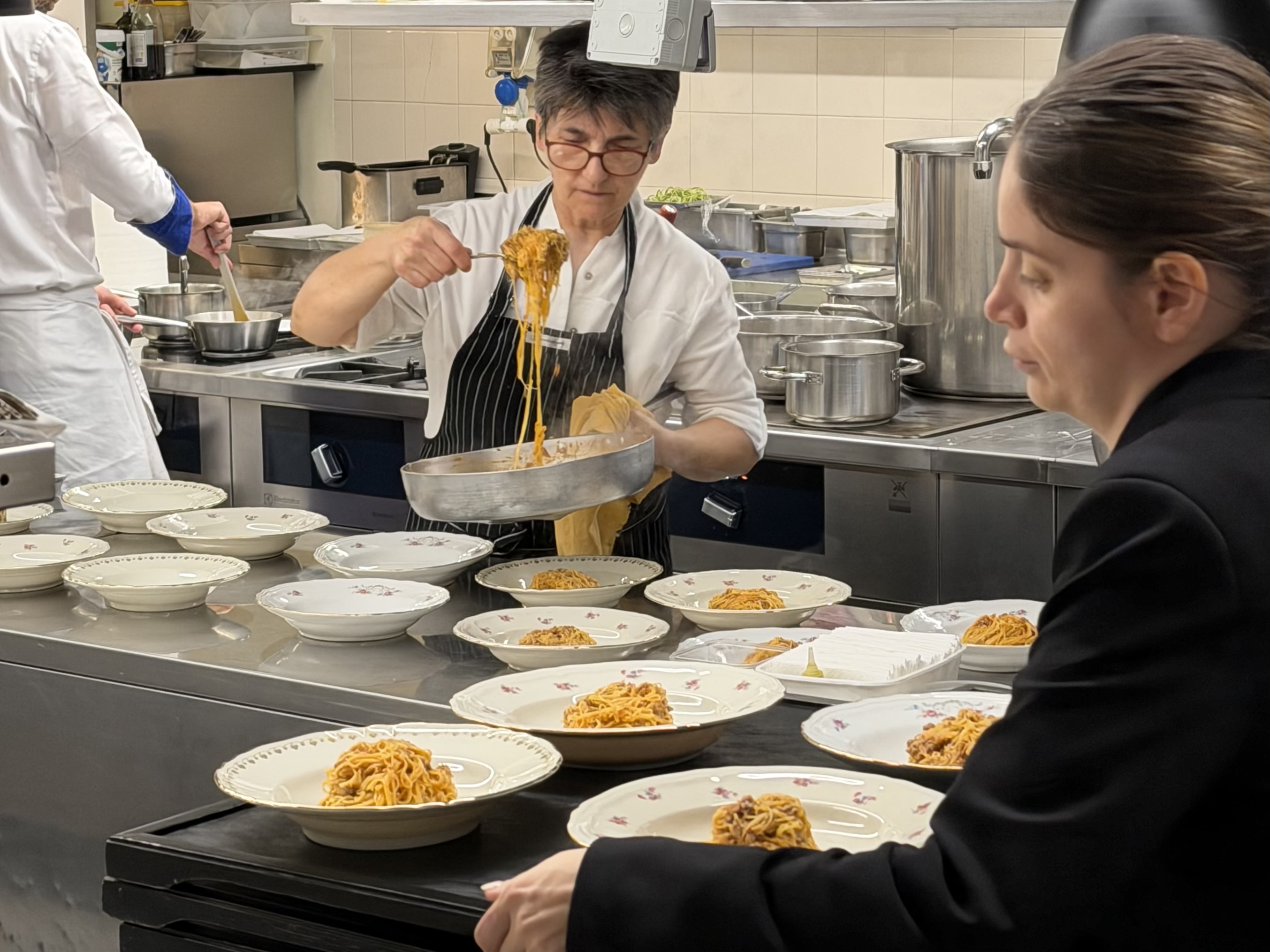
We went to Il Centro for a personal celebration, but the image that would remain with us was taking shape away from the dining room. In the kitchen, Elide Mollo stood behind a long row of porcelain plates, holding a large pan filled with tajarin already mixed with ragù. She lifted the pasta, gathered its fine golden strands and placed an equal nest into each plate. The gesture was precise and generous, repeated without ceremony, as though the history of the restaurant had found its most natural expression in this simple movement.
Il Centro has occupied a place in the life of Priocca for far longer than its Michelin star might suggest. The restaurant had already been serving the village for more than a century when Pierin Cordero and his wife Rita acquired it in 1956. Together with Pierin’s mother Lidia, they shaped the house around the flavours of the Roero and a form of hospitality in which regional cooking, wine and conversation belonged to the same experience.
After Pierin’s death in 1970, Rita continued the story from the kitchen while their son Enrico, then only eighteen, left school to take responsibility for the restaurant. She remained faithful to the dishes that had built its reputation, from finanziera and fritto misto to the light, finely cut tajarin that would gradually become one of Il Centro’s signatures. When Elide arrived in 1983, she inherited this repertoire and began refining it with discretion, preserving its generosity while bringing greater precision and balance to its flavours.
Today, Elide remains at the stoves while Enrico welcomes guests in the dining room and their son Giampiero watches over an extraordinary cellar. Great bottles from Piedmont, the rest of Italy and France encourage the kind of lunch that can stretch almost indefinitely, but wine is only one part of what makes Il Centro an institution. Its identity rests on the continuity of a family house where the passing of time has deepened the cooking rather than distanced it from its origins.

The tajarin al ragù reveal this continuity immediately. Made with fresh eggs and cut into exceptionally fine strands, they are mixed with the sauce in the kitchen before being divided between the waiting plates. Nothing is left to chance, yet nothing appears calculated. The pasta absorbs the ragù without becoming saturated by it, retaining its golden colour and delicate texture beneath a sauce that brings depth rather than weight.
Once the plate reaches the table, cheese is grated directly over the tajarin. It falls in fine flakes across the pasta, completing a dish whose appearance has no interest in seduction for its own sake. The porcelain, the golden nest, the ragù caught between the strands and the final shower of cheese form an image that feels almost timeless. The plate could belong to another decade, yet nothing about its flavour feels dated.

Around the fork, the strands gather with remarkable ease. Their fineness creates a texture that is almost weightless, while the eggs give the pasta enough richness to carry the concentration of the ragù. The sauce remains present in every mouthful without obscuring the pasta itself, and the cheese brings the final touch of salinity. Each element seems to know precisely how much space it should occupy.
These are the best tajarin we have tasted. The statement does not come from an unexpected ingredient or an impressive technical effect, but from the rare sensation that nothing needs to be added, removed or explained. The dish offers immediate pleasure, then gradually reveals the experience hidden behind its simplicity. Decades of repetition have not made it mechanical; they have made it exact.
The tajarin also carry the history of Il Centro in a way that no framed photograph or collection of awards could achieve. Lidia’s instinct, Rita’s fidelity and Elide’s refinement are still present in the same plate, connected by a recipe that has passed between generations without becoming frozen in time. Its evolution has happened through small adjustments, within the thickness of the pasta, the lightness of the ragù and the confidence of the hand that serves it.

We came to Priocca for a moment that already mattered to us, and Il Centro gave it a flavour we will remember. From now on, every plate of tajarin will be measured against the sight of Elide lifting them from the pan, the line of porcelain plates waiting on the counter and the cheese falling over the pasta at our table. Some restaurants are remembered through their menus; Il Centro can be remembered through a single dish.
Leave a Reply