
The 2026 harvest arrived in Champagne with almost no warning. At Abelé 1757, the first juices entered the winery on August 14, an unusually early date that immediately set the tone for the vintage. Chardonnay was coming in ripe, sometimes very ripe, forcing the cellar team to think less about reaching maturity than about preserving what Champagne has always depended on: freshness, tension and the possibility of building balance later through blending. In the winery, stainless-steel tanks dominate, chosen for the precision they allow, while a small number of barrels are used with restraint, not to leave an obvious imprint but to bring texture, spice and another dimension to certain components. The philosophy is already visible here. Nothing is intended to speak louder than the wine itself.

The size of the tanks tells another part of the story. Abelé 1757 deliberately works with relatively small volumes so that parcels, growers and individual origins can remain separate for as long as possible. In a year like 2026, this becomes particularly useful. Some batch may bring maturity, others acidity, some breadth, others a finer line. The blend is not simply the final act of Champagne making; it is the moment when all those differences become useful. The faster the climate moves, the more valuable this ability to keep options open becomes. Champagne once worked principally to protect itself from underripeness. Today, part of the job is increasingly about controlling excess.

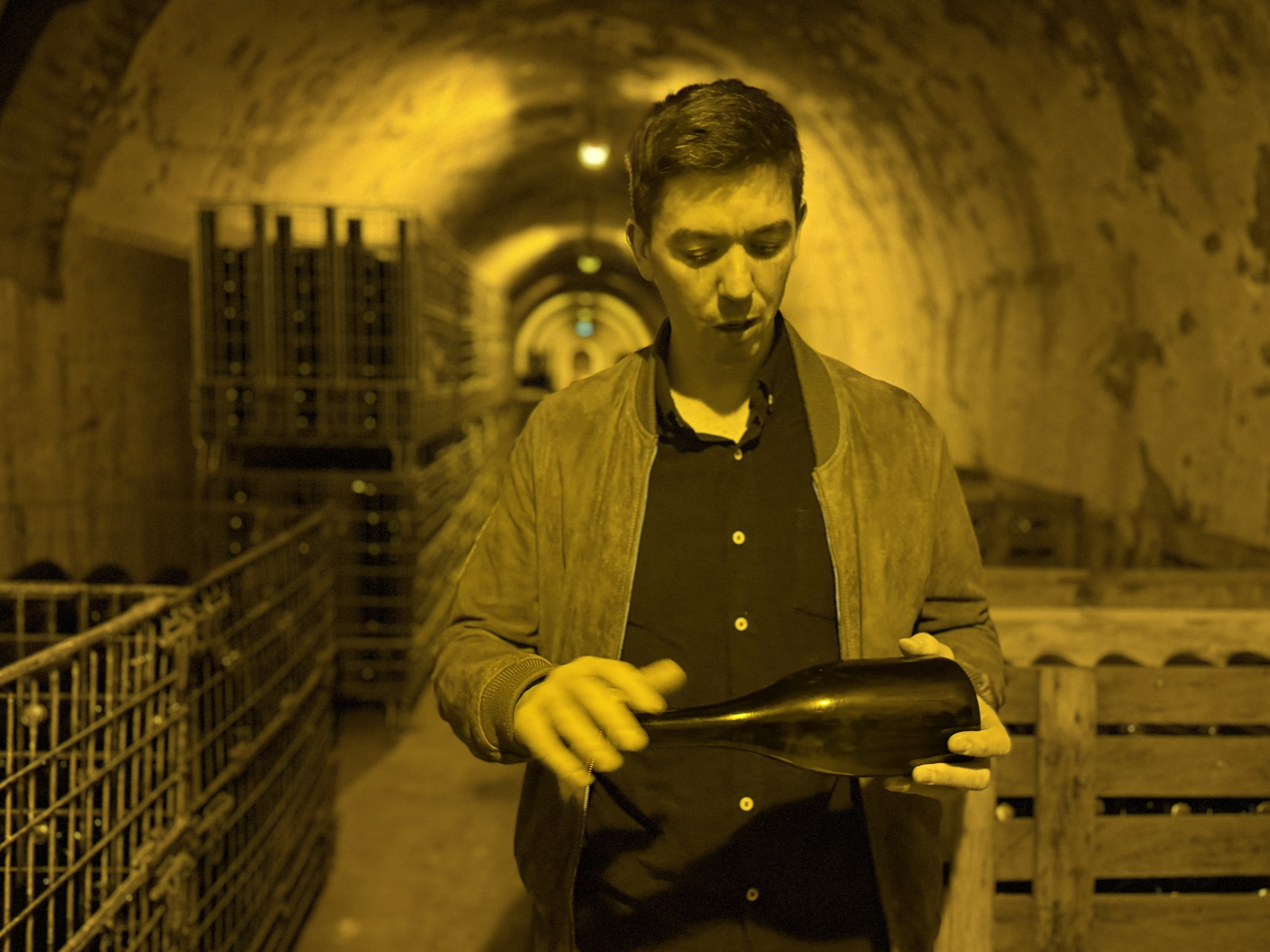
Then comes the descent into the cellars. Around ninety steps lead beneath Reims, almost twenty-five metres underground, into the chalk. The change is immediate. The air becomes cooler and heavier, the light disappears, and the rhythm of the winery above suddenly seems very far away. Abelé 1757 has close to two kilometres of cellars cut into this chalk beneath the city. Their scale is modest compared with the spectacular underground networks of some larger houses, but that is perhaps what makes them interesting. These are not caves conceived as scenery and it is usually not possible to visit them. They remain working cellars, shaped around the volumes and methods of the house. Bottles rest in the darkness for years, sometimes for more than a decade, while the temperature remains almost unchanged around 14 degrees all year long.

The walls still carry traces of those who worked here before: inscriptions, crosses, drawings and fragments of another period of Reims. Behind stacks of bottles sits another kind of memory, the collection of old vintages kept by the house. Some date back to the first half of the twentieth century. They are now treated as an archive rather than simply as old stock. Corks are checked and occasionally replaced, levels corrected when necessary, bottles examined before being returned to the cellar. In the past, these collections were sometimes created almost accidentally, through a few bottles remaining at the end of a tirage. Today the process is deliberate. Each new generation sets bottles aside so that someone else may open them fifty or one hundred years later. The cellar is therefore not only storing wine; it is slowly constructing the memory of the house.

It is deeper inside these caves that the identity of Abelé 1757 becomes clearest, around the bottles of Le Sourire de Reims. The name is inseparable from the cathedral above. During the bombardments of Reims in 1914, fire severely damaged the cathedral and the statuary of its north portal. Among the sculptures affected was the angel whose expression would later give it its name: L’Ange au Sourire. Its damaged face quickly became an image of a wounded city and, soon after, of its reconstruction. Henri Abelé, then at the head of the family house and already closely involved with the cathedral, took part in that movement. In 1918, even before the war had completely ended, he created the name Le Sourire de Reims, linking the Champagne house to the restoration of one of the city’s most recognisable symbols. More than a century later, the cuvée remains the clearest expression of that connection.

Today Le Sourire de Reims exists in two very different interpretations. The white, currently represented by Le Sourire de Reims Brut 2013, combines Chardonnay and Pinot Noir and spends around a decade ageing before release. The idea is not simply to produce an older Champagne. Ageing is used to develop breadth without losing movement. The Chardonnay provides the direction, the Pinot Noir fills the centre of the wine, and time brings the rest: brioche, dried citrus, spice and a more complex fruit expression. Yet what defines the cuvée is less a list of aromas than the way it remains held together. There is maturity, but not fatigue; density, without heaviness. The wine has had time to expand without losing the line that allows it to remain Champagne.
That distinction matters. Long ageing can easily become a style in itself, particularly in prestige cuvées, where oxidative notes are sometimes almost expected as proof of seriousness. Le Sourire de Reims follows another path. The cellar aims for a moment when primary fruit has disappeared, autolysis has given texture and aromatic complexity, but the wine has not yet surrendered its energy to age. Finding that moment requires patience, but also judgement. A bottle does not become ready simply because ten years have passed. It becomes ready when time has changed it without erasing what made it alive.

The Le Sourire de Reims Rosé 2008 is almost another wine entirely. Made exclusively from Pinot Noir from Les Riceys and produced as a rosé de saignée, it carries more colour, more structure and a distinctly vinous personality. Here, rosé is not treated as a lighter variation on the white cuvée. The maceration places Pinot Noir at the centre of the composition and gives the wine a different relationship with food. Its red-fruit profile is deeper, its texture broader and its bitterness slightly more present. It moves naturally towards the table, not only towards aperitif service. Tuna, cured meats or Ibérico ham are obvious directions, but the wine also has enough structure for duck, pigeon or preparations involving spice and reduction.
Only a small number of bottles are produced. Around 1,500 bottles of the Rosé are made, while the white is also released in limited quantities. That scarcity is not presented as an exercise in exclusivity so much as the consequence of how the wines are produced. Some bottles undergo manual poignetage during ageing, the lees being put back into suspension several times to encourage autolysis and increase texture. Large formats are increasingly kept in their original tirage bottle rather than produced through transvasage. After disgorgement, the wines are given additional time before release so that the dosage can integrate completely. None of these gestures transforms the wine by itself. Together, they reveal the degree of attention being paid to the final texture.

The contrast becomes most apparent when returning upstairs. Above ground, the 2026 vintage is fermenting at a speed that would have surprised previous generations. Harvest dates continue to move forward, ripeness arrives faster, and Champagne is being forced to rethink assumptions that once seemed permanent. Below ground, however, nothing can be accelerated quite so easily. A millésime still needs years in the dark. The lees still need time to act. A dosage still needs to settle into the wine. The bottles of Le Sourire de Reims cannot be rushed simply because the vineyard outside is moving faster.
Le Sourire de Reims is still learning how to wait. And perhaps that is the point: while the vineyards move faster, the cellars continue to remind us that the most important part of Champagne cannot be hurried.
Leave a Reply