
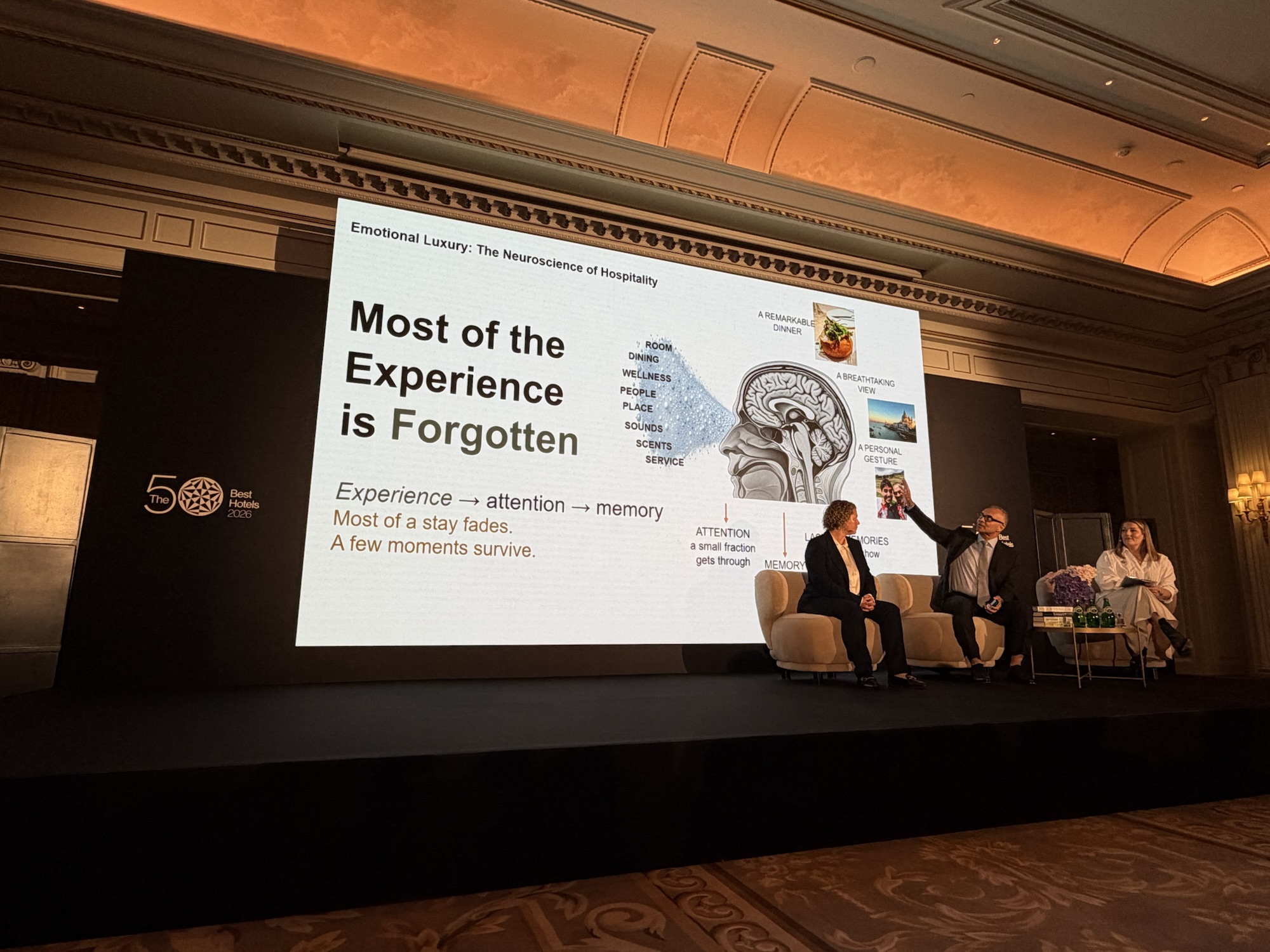
At The 50 Best Talks: Unpacked, held in Paris ahead of The World’s 50 Best Hotels 2026, Jenny Southan, founder and CEO of Globetrender, and Dr Atom Sarkar, MD, PhD, approached the hotel experience from an unusual starting point. Rather than asking how a property can become more spectacular, more comfortable or more sophisticated, they looked at what happens once the experience is over. What does the guest actually remember? And if memory retains only fragments of a stay, should hotels think differently about what they are trying to create? The official takeaways from the session framed the discussion around attention, emotion and memory, against a backdrop of growing fatigue with conventional markers of high-end travel.
Hotels have spent decades perfecting what can be seen, measured and compared. Rooms have become larger, service more precise, restaurants more ambitious, spas more elaborate and experiences increasingly personalised. None of these things has become irrelevant. But Jenny Southan and Atom Sarkar introduced another question into the equation: once the guest has gone home, how much of any of it does he remembers?
Probably much less than hotels imagine. A guest may no longer remember the dimensions of the room, the exact sequence of a dinner or most of the service gestures that made the stay run smoothly. Yet one conversation, an unexpected gesture, a smell, a particular music or silence or the light entering a room early in the morning can remain for years. The experience might have lasted several days; memory eventually reduces it to a handful of moments.
For Dr Atom Sarkar, understanding that process begins with attention. During a stay, the brain receives an enormous quantity of information: architecture, people, sounds, food, lighting, temperature, movement and countless details intended to shape the experience. It cannot preserve all of them. What has a chance of remaining must first capture attention, then acquire enough emotional significance to enter memory. The conclusion summarised after the talk was direct: attention combined with emotion creates memory.
Atom Sarkar’s description of memory was particularly relevant to hospitality. We tend to imagine remembering as replaying something that has been stored intact. His explanation was much less orderly. Memory is reconstructed from fragments. A few pieces of an experience survive and are subsequently assembled into the story we tell ourselves about what happened. The sequence may become inaccurate; some elements disappear entirely; others grow in importance over time.
A restaurant provides an obvious example. Nobody needs to remember every dish of a tasting menu for dinner to remain significant. Months later, one plate may represent the entire meal. Or perhaps the food itself has receded and what remains is the conversation taking place across the table. The same happens in hotels. A room experienced for three nights can gradually disappear from memory while a twenty-second interaction with a member of staff becomes the story of the stay.
The hotel is experienced as a whole, but remembered selectively. That creates a curious contradiction. Hotels are built around completeness. The arrival matters, the room matters, breakfast matters, the temperature matters and departure matters. Everything needs to work together. Yet none of those elements earns a place in memory simply because it was correctly delivered. Operational excellence makes the experience possible; it does not determine what the guest will eventually retain.
Jenny Southan introduced another tension into the discussion. Travellers who repeatedly stay in remarkable hotels and eat in celebrated restaurants can gradually become more difficult to surprise. Exceptional environments do not necessarily stop being appreciated, but familiarity can reduce their emotional impact. The official notes from the session describe this as a form of fatigue, with travellers increasingly looking beyond the traditional accumulation of stars, amenities and other visible signs of prestige.
That changes the question facing hotels. For a long time, progress has often been expressed through addition: another restaurant, another treatment, more technology, a larger room, another service. But more does not necessarily produce more memory. At some point, accumulation begins competing with attention.
The distinction raised during the discussion is subtle but useful. A spa is something a hotel possesses; calm is something a guest feels. A restaurant can be constructed; anticipation or surprise cannot. A suite can be designed precisely, but intimacy does not automatically follow. The physical product creates the conditions. The emotional response belongs to the guest.
One of the most unexpected parts of the conversation concerned discomfort. Hotels have traditionally tried to remove friction. Service anticipates needs, technology reduces waiting, rooms control sound and temperature, and transport removes uncertainty. Yet Jenny Southan pointed towards a different movement: travellers seeking experiences involving difficulty, effort or a temporary loss of control. The session notes suggest that deliberately chosen discomfort can acquire value when it contributes to challenge, growth or a stronger emotional response.
The example discussed was a collaboration between Mandarin Oriental Tokyo and The Luminaire, taking guests out of the city and into the mountains to spend time with Yamabushi monks. Meditative walks, icy waterfalls and rituals of repetition form part of an experience that asks something of the traveller rather than simply insulating them from difficulty.
The point is not that inconvenience has become desirable. An uncomfortable bed remains an uncomfortable bed. Poor service does not acquire meaning because it creates frustration. There is a fundamental difference between imposed inconvenience and voluntary difficulty. In the latter, the guest becomes an active participant. Something has to be crossed, endured or discovered. The value comes partly from what the individual has invested in reaching the other side.
Perhaps that is why some travel memories attach themselves to moments that were not particularly comfortable: the walk before sunrise, cold water, silence, an unexpected detour or physical effort. Hotels have spent decades asking how they can remove friction. Another question may now matter just as much: where should comfort remain absolute, and where might effort give an experience meaning?
The conversation then returned to the original meaning of hospitality. Atom Sarkar spoke about the relationship between host and guest and about care as something more fundamental than service procedure. Modern hotels necessarily work through systems: what has been booked, which preferences are recorded, what the guest normally drinks, when the room should be prepared. But information about a guest and attention to a guest are not the same thing.
Data can make an experience smoother. Attention requires interpretation. A preferred pillow can be stored in a profile. Recognising that someone needs silence rather than conversation cannot always be. A favourite bottle can be remembered easily ; understanding whether opening it at a particular moment will feel generous or excessive remains something else. The official summary of the session describes a move away from a purely transactional relationship towards asking what the guest needs, desires and what might make them feel secure.
That difference is important because personalisation can become mechanical. Using a guest’s name, knowing their breakfast order or remembering their room temperature can all improve a stay without necessarily creating any emotional connection. Attention begins where the profile ends. Sometimes it produces a gesture. Sometimes the most attentive decision is to do nothing at all.
Storytelling entered the conversation from the same perspective. Hotels increasingly construct stories around architecture, heritage, local culture, restaurants and design. But Atom Sarkar’s explanation of memory suggests that the property is not the only author. The guest rewrites the story afterwards. They keep some fragments, discard others and connect them in ways the hotel cannot fully control.
That matters in an industry increasingly comfortable with words such as authentic, immersive, meaningful, transformative and unforgettable. An experience does not become memorable because its description says it will be. The official conclusions from the discussion make the distinction clearly: genuine memory comes from something sensory and felt, rather than from clever language surrounding it.
A ritual does not become meaningful because it has been labelled a ritual. A local experience is not automatically memorable because a producer has been introduced. Using someone’s first name does not automatically create intimacy. Something has to happen strongly enough for the guest to carry part of it away.
That inevitably leads to the most difficult question raised by Jenny Southan and Dr Atom Sarkar: can memory actually be designed? Not entirely. A hotel cannot decide that a guest will feel wonder at a given moment or guarantee that a conversation will still be remembered fifteen years later. What it can do is create the conditions in which those responses become more likely.
The session proposed thinking in terms of an architecture of emotion: identifying a limited number of feelings a hotel wants to encourage, then questioning whether its spaces, service and experiences genuinely make those feelings possible.
The interesting consequence is that this may lead to adding less rather than more. If calm matters, perhaps fewer interruptions matter more than another programme. If curiosity matters, not everything needs to be explained. If intimacy is important, what has been removed from a room may matter as much as what has been placed inside it.
Attention needs space. This may be one of the most useful conclusions to take from the discussion. Hotels have long celebrated their attention to detail, but attention to detail and attention from the guest are not the same thing. Hundreds of details may be flawlessly executed while only two or three become conscious enough to survive in memory.
The other details are not wasted. They form the invisible structure supporting the experience. But this changes the question from how much a hotel can provide to where the guest’s attention should be allowed to settle.
Hotels are particularly good at measuring the immediate aftermath of a stay. Satisfaction surveys arrive quickly, reviews are written within days and returning guests provide another indicator. Memory follows a different timetable. What is still there six months later? What does someone mention first when asked about the hotel? Which small part of a three-day stay eventually comes to represent the whole?
Perhaps this is where certain hotels separate themselves from others. Not because everything was exceptional and not because every interaction tried to become memorable, but because something remained.
Leave a Reply