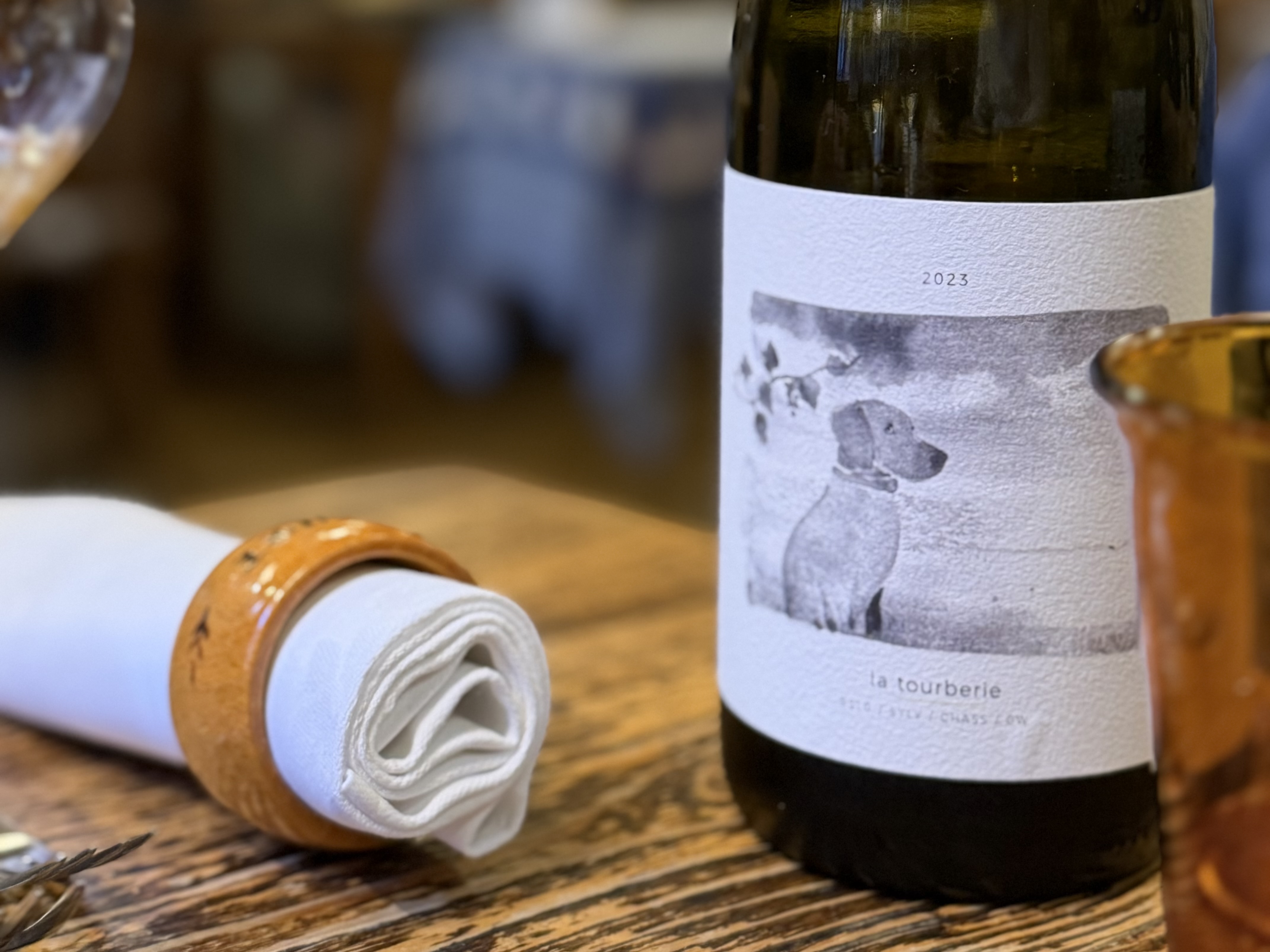
By the time a sommelier encounters a wine, the harvest has been completed, the élevage decided and the bottle closed. Jean-Baptiste Klein, enters this story earlier, through a selection made at La Grange de l’Oncle Charles in Ostheim. His name appears on the back label alongside Morgane, Vanessa, Jérôme and Tourbe, his dog who gives the cuvée its name. This detail immediately changes the way the bottle is understood. La Tourberie does not carry a single signature. It emerged from a relationship.
Jean-Baptiste Klein has been Head Sommelier at Le Chambard in Kaysersberg since 2016. Awarded the title of Meilleur Ouvrier de France in Sommellerie in 2018, he has developed a cellar in which Alsace occupies a central position. The intention is not simply to defend regional wines, but to encourage guests to explore the vineyards surrounding the restaurant and understand the different readings of the Alsatian landscape. Le Chambard presents La Tourberie explicitly as a cuvée selected by Klein, giving the sommelier’s choice a visible place in the identity of the wine.
The encounter could hardly have found a more natural setting. Before becoming a winemaker, Jérôme François trained as a carpenter, in 2014, he established La Grange de l’Oncle Charles using a few rows of vines inherited from his grandfather and the agricultural barn of his great-uncle Charles. Working today alongside Morgane Stoquert, he has developed an approach based on biodynamic farming, mixed plantings and limited intervention in the cellar. Horses work between the vines, sheep graze through the parcels and the wines are allowed the time required to find their own balance.
This history matters because La Grange de l’Oncle Charles has never treated the grape variety as the only possible language of Alsace. Jérôme François was influenced by a vision of wine in which different varieties coexist within the same parcel and contribute collectively to the expression of a place. His encounter with Jean-Michel Deiss reinforced the conviction that a wine should reveal the complexity of its origin rather than reduce it to the recognisable character of a single grape. The resulting wines attempts to preserve the relationships already present in the vineyard.
La Tourberie comes from old massal selections rooted in marl soils. After fermentation, the wine was aged for twenty-two months in barrel, then bottled dry and unfiltered at 13% alcohol on 7 August 2025. Rather than being defined by a single grape variety, the cuvée reflects the age and diversity of the vineyard, the character of its soils and the depth gained through a long élevage.
This is where Jean-Baptiste Klein’s contribution becomes particularly interesting. A sommelier does not normally participate in the agricultural life of a wine, nor should his involvement be confused with that of the winemaker. His expertise lies elsewhere. He observes how a wine moves: how it opens, changes with temperature, responds to food and continues beyond its first aromatic impression. Beyond judging a wine as it is, he learns to anticipate what it could become once it leaves the cellar and enters the dining room.
Selection then becomes a form of editorial judgement. It does not alter the original voice of the wine; it identifies the expression that deserves to be heard separately. In La Tourberie, the sommelier is neither a distant buyer nor a name added to the bottle for prestige. His presence acknowledges a conversation between winemaker and the sommelier, between the person who accompanies the wine through fermentation and the person who will later accompany it through a meal.
This relationship also reflects a change taking place within contemporary sommellerie. The profession is no longer confined to assembling an impressive list or matching one bottle with one dish. Its most committed sommeliers spend time in the vineyards, follow the work of emerging estates and sometimes help create the conditions in which an overlooked parcel, barrel or interpretation can reach the table. Intuition remains essential because not every decision can be reduced to a technical score. It requires experience, but also the ability to recognise emotion before it has been fully defined.
La Tourberie 2023 is therefore not simply a wine carrying a sommelier’s selection. It is a bottle shaped by several forms of attention: the winemaker reading the vineyard and the sommelier recognising a particular expression within the cellar. Its originality does not come from adding another author to the wine, but from accepting that a terroir can sometimes become clearer through the relationships surrounding it. Here, intuition does not compete with the land. It helps us notice what the land has already begun to say.