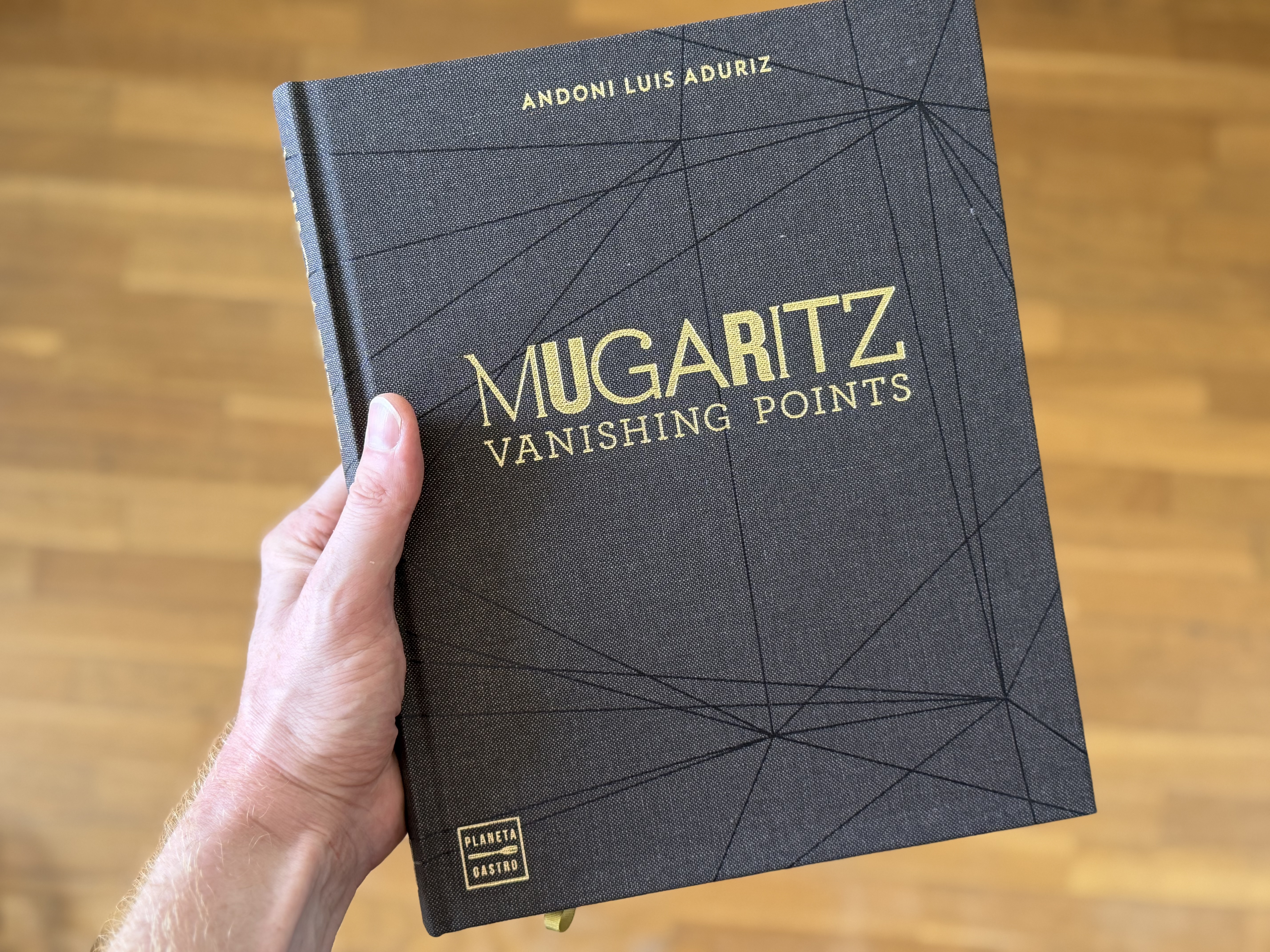
Mugaritz, Vanishing Points gathers twenty years of research, intuition and collective experimentation around Andoni Luis Aduriz and the singular world he has built in the Basque Country. Conceived as a chronicle in motion rather than a retrospective, the book approaches Mugaritz through essays, photographs, drawings, handwritten reflections, culinary sketches and fragments of thought. Its ambition is not to provide a definitive portrait of the restaurant, but to follow the trajectories of a project that has never stopped questioning its own form, its purpose and the meaning of the experience it offers.
Alex Atala opens the volume by describing Mugaritz as a portal through which the cuisine of its time must pass. The image is particularly accurate. Throughout the book, the restaurant appears as a place of transition, where familiar ideas about taste, pleasure, hospitality and the role of a chef are displaced before being reconsidered. Rankings and recognition remain secondary to the possibility of creating something unique, while provocation and incomprehension are treated not as failures of communication, but as legitimate parts of the dining experience.
The title refers to the distant point where lines seem to converge, but it also suggests a horizon that continually recedes as one moves towards it. For Andoni Luis Aduriz, these vanishing points are not fixed destinations. They are directions, intuitions and unfinished paths that allow Mugaritz to remain in movement. The book is built around this tension between structure and uncertainty, between the desire to give shape to an idea and the need to leave enough space for that idea to escape its initial definition.

Its architecture reflects that principle. The chapters are organised around questions and states of mind rather than conventional culinary categories. “To rebel or to obey?”, “Is this any good?”, “Who is in the kitchen?” and “Is there anybody out there?” introduce territories shaped by transgression, faith, pleasure, entropy, deception, memory, stubbornness and doubt. The vocabulary of cooking gradually expands into philosophy, biology, literature and human behaviour, until the restaurant itself becomes one possible lens through which to examine the world.
One of the most revealing passages explores exaptation, a term borrowed from biology to describe the process through which a characteristic acquires a function different from the one for which it originally appeared. Feathers, once used for insulation, eventually enabled flight. Andoni Luis Aduriz applies the same logic to the restaurant. Can a place originally created to feed become a space for research, reflection or intellectual disturbance? Can hospitality generate something other than comfort? The book leaves these questions open, because its purpose lies precisely in preserving the possibilities created by them.
This resistance to certainty is also expressed through the design. Translucent pages, handwritten declarations, photographs, drawings and preparatory sketches interrupt the rhythm of the essays and require the reader to change perspective. Some pages look like a research notebook, others a manifesto, a collage or an unfinished conversation. The object does not simply illustrate Mugaritz’s ideas. Its construction reproduces the instability, curiosity and creative friction that sustain them.

The dishes occupy an important place, but they rarely appear as conclusions. They are presented as hypotheses, fragments or temporary solutions to wider questions. A sketch may reveal the evolution of an idea, while a handwritten phrase exposes the tension, humour or doubt that accompanied its development. Even the recipes resist the usual promise of reproducibility. Their purpose is less to transmit a result than to reveal the movements of thought, trial and reconsideration that preceded it.
This becomes particularly clear in the book’s reflections on disobedience.
“Just as you can’t make an omelette without breaking eggs, you can’t fly without daring to leap”
It appears as both a culinary image and a declaration of method. At Mugaritz, rebellion does not mean rejecting every rule for the sake of provocation. It means identifying which conventions still serve a purpose and which have become habits protected from scrutiny. The restaurant’s freedom comes from its willingness to expose those habits and accept the uncertainty that follows.

The text “Mugaritz Time” by Harkaitz Cano brings another dimension to the project. Time is described as something invested, borrowed, wasted, endured and shared, a substance shaped by gestures and attention. If cooking requires gestures, then cooking also sculpts time. Preparing food for another person connects two temporalities: the one who cooks and the one who waits, the one who offers and the one who receives. Through this poetic meditation, the book reminds us that cuisine is never limited to the food itself. It is also made of duration, anticipation, memory, rhythm and disappearance.
This relationship with time runs through the entire volume. Vanishing Points looks back over two decades without turning them into a monument. The past is gathered as material for future transformations, not as proof of a completed achievement. Mugaritz appears as a collective construction shaped by chefs, writers, artists, designers, scientists and diners, each contributing to a project whose identity depends on its capacity to remain unfinished.

The book therefore occupies an unusual place within gastronomic publishing. It documents a restaurant while refusing to stabilise it. It presents dishes while questioning what a dish can contain. It reflects on hospitality without assuming that comfort is its only possible expression. Its pages ask the reader to consider whether a restaurant may also become a site of doubt, a workshop for ideas and a place where eating can disturb as much as it reassures.
Mugaritz, Vanishing Points is read through pauses, returns and changes of direction. Certain excerpt illuminate the restaurant’s philosophy, while others deliberately preserve its opacity. Together, they form the portrait of a cuisine that does not seek to close the conversation. The restaurant remains an open question, and the book’s greatest strength lies in allowing that question to retain its full force.