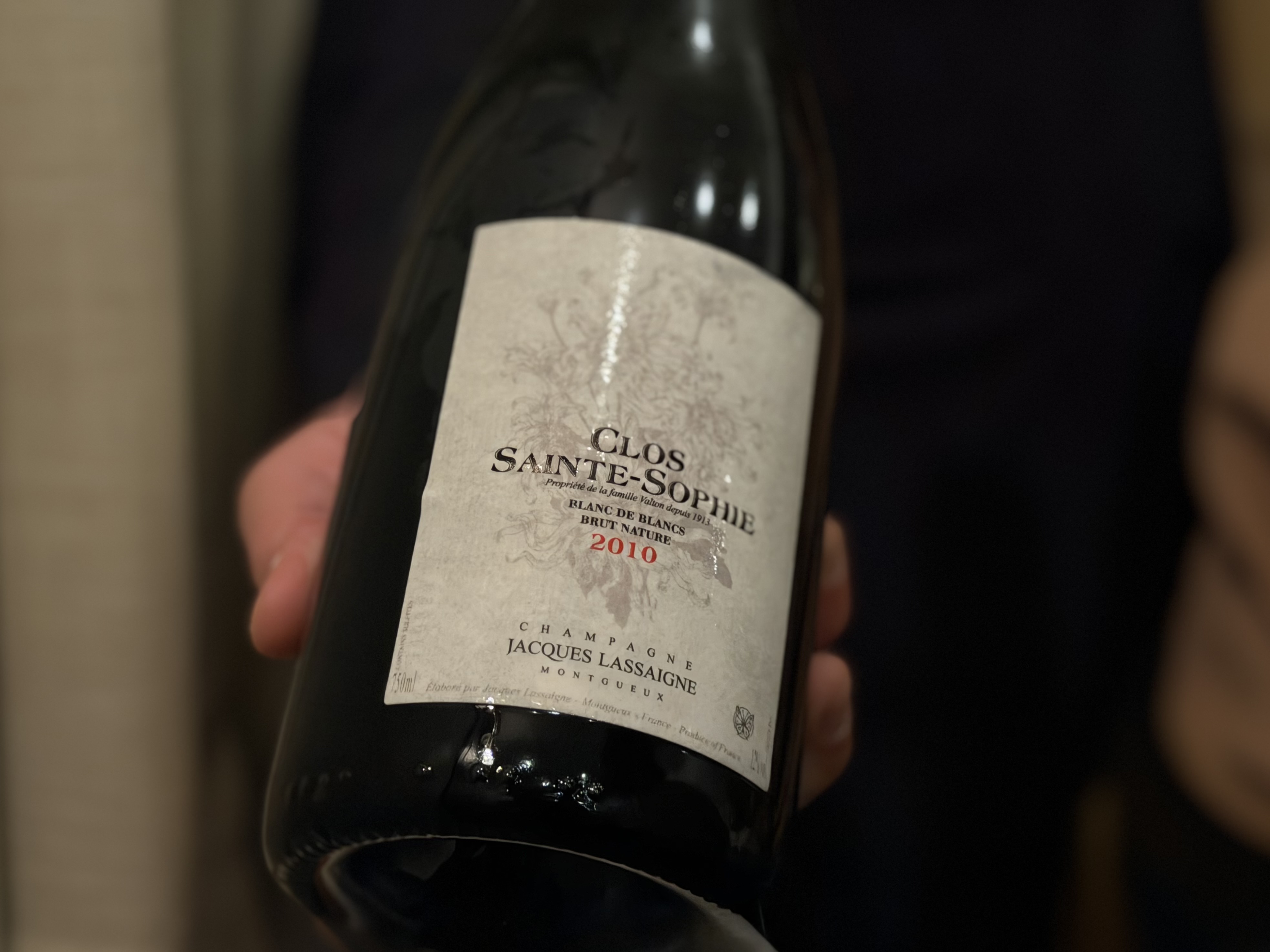
Poured at the end of the Champagne à Table dinner at Zostera, Emmanuel Lassaigne’s Clos Sainte-Sophie 2010 revealed a wine shaped by fifteen years of waiting and a vineyard whose history reaches from Champagne to the origins of modern Japanese winemaking.
Clos Sainte-Sophie arrived after dessert, once the structure of the dinner had already come to an end. There was no dish left to interpret it and no pairing intended to frame its expression. The bottle appeared as a final return to Montgueux after a menu that had explored the different ways Emmanuel Lassaigne works with Chardonnay, barrel ageing, still wine and the traces left by time.
The wine was Clos Sainte-Sophie 2010, the first vintage Emmanuel Lassaigne produced separately from this enclosed vineyard. After the more experimental expressions served earlier, including the vin-jaune-barrel-aged Autour de Minuit, the cuvée brought the tasting back to a broader and more settled form of Chardonnay. It felt concentrated and buttery, yet the saline, almost iodised character of Montgueux remained present beneath its maturity.
Montgueux resists easy comparison. Its vineyards stand apart from the main Champagne regions, on a hill west of Troyes where chalk and flint shape a Chardonnay capable of generosity without losing its tension. In Clos Sainte-Sophie, this contrast becomes particularly clear. The wine opens with depth and breadth, then gradually returns to precision.
From 2010 onwards, Emmanuel Lassaigne chose to vinify Clos Sainte-Sophie separately, allowing the parcel to emerge as a distinct expression of Montgueux. Rather than letting the fruit disappear into the broader language of the estate, he gave the wine the time required to reveal its own character. The cuvée became a study of place and patience: one vineyard, one vintage and the slow development of an identity that could not have been reproduced elsewhere.
Emmanuel Lassaigne compared this evolution to what happens in mature Chablis. Youth can initially broaden and soften a wine, while additional ageing gradually reveals the saline structure beneath the fruit. Clos Sainte-Sophie 2010 followed that movement. Time had not erased the chalk, it had changed the way it appeared. The salinity was no longer immediate or sharp. It emerged through the length of the wine, once the richer textures and developed aromas had begun to recede.
Yet the importance of Clos Sainte-Sophie does not rest only in its taste. The vineyard also occupies a place in the history of Japanese wine. In 1877, the newly created Dainippon Yamanashi Budoshu sent Masanari Takano and Ryuken Tsuchiya from Katsunuma to France to study grape growing and winemaking. Records from the Koshu Valley place them in Champagne between October 1877 and March 1879, while local history in Montgueux identifies Clos Sainte-Sophie as one of the places where they trained.
Their return to Yamanashi contributed to the first organised attempts to establish modern wine production in Japan. The European grape varieties they initially tried to cultivate struggled in the local conditions, but the techniques learned in France became part of the foundation upon which Japanese wine would develop. Katsunuma later emerged as the historical centre of the country’s wine culture, particularly through a growing understanding of Koshu and its ability to produce dry white wines.
This connection gives Clos Sainte-Sophie an unusual geographical reach. A small enclosed vineyard near Troyes became part of a movement that continued thousands of kilometres away, at the foot of Mount Fuji. The link is not simply a historical detail attached to a rare bottle. It reflects the circulation of knowledge: the way viticulture is learned, adapted and transformed when it passes from one climate and culture to another.
The 2010 poured at Zostera carried both dimensions of the clos. It was first a wine of Montgueux, shaped by old Chardonnay vines, chalk and extended ageing. But it also recalled a vineyard that once served as a place of apprenticeship. One history remained inside the bottle; the other had travelled to Japan.
That evening, Clos Sainte-Sophie did not need a final plate. After the peach, seaweed and rosé Champagne that closed Julien Dumas’s menu, the wine returned the dinner to the land, to patience and to transmission. In the last glass, a single parcel near Troyes opened onto a story that had travelled as far as Katsunuma.