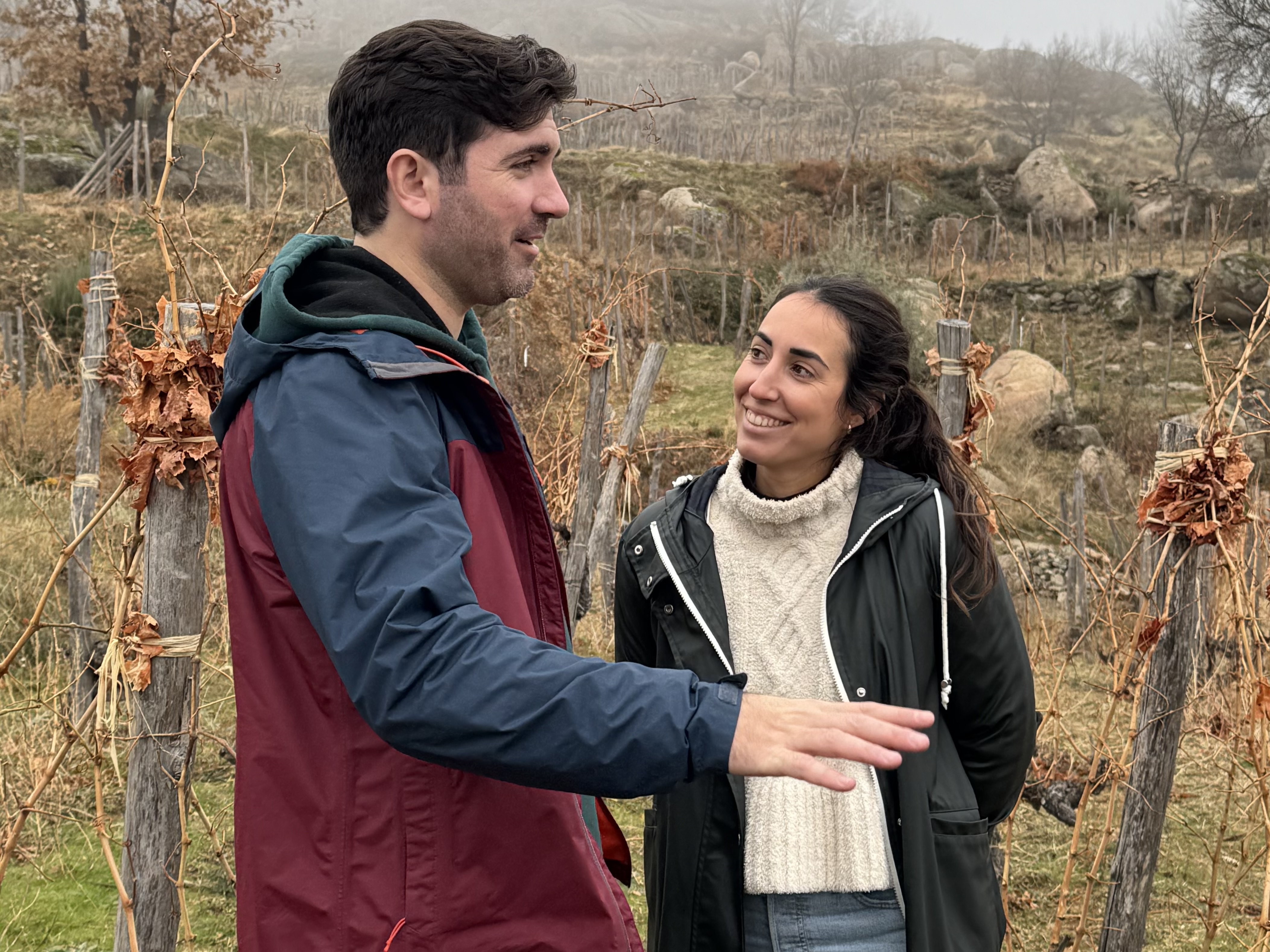
Around one hundred kilometres west of Madrid, the road begins to rise towards the Sierra de Gredos. The urban landscape gradually disappears, replaced by granite, forests, narrow valleys and villages whose relationship with agriculture has weakened as part of their population has moved away. In Navarrevisca de Gredos, within the D.O.P. Cebreros, Emmanuel Campana and Carmen de la Pascua chose this demanding landscape as the starting point for Domaine Dexaïe.
They did not choose Navarrevisca because it offered an easy place to build a domaine. They chose it despite the fragmented parcels, difficult access and amount of manual work required, because its old vineyards were worth bringing back to life. Many had been neglected as cultivation became too demanding or economically uncertain. Emmanuel and Carmen saw in them not abandoned land, but the remains of a viticultural culture that could still be preserved.

Domaine Dexaïe has therefore grown through a patient process of recovery. Parcels have been identified, purchased or regrouped, while terraces have been cleared and paths reopened. The work is slow because each vineyard requires its own response, and because the geography rarely allows machinery to replace human labour. Here, manual viticulture is not presented as a stylistic choice. It is the direct consequence of the mountain.
The vines grow at altitude, rooted in granite soils and exposed to the air that moves through the valleys. This circulation of wind helps maintain freshness and keeps the vineyards relatively healthy, while the cooler conditions contribute to the tension found in the wines. The landscape shapes the rhythm of the growing season, and Emmanuel and Carmen have chosen to follow that rhythm rather than force it into a fixed model.

Their work begins with observation. They look at how an old vine responds after years of limited care, how one exposure differs from another and how the same variety changes across neighbouring parcels. Garnacha may dominate the region, but Domaine Dexaïe approaches it not as a uniform identity, but as a grape capable of recording altitude, soil, orientation and the history of each vineyard.
This sensitivity continues in the cellar, where the wines are treated as extensions of the parcels rather than as products built around a recognisable winemaking formula. The objective is not to erase differences in order to create a single house style. It is to preserve enough of those differences for the landscape to remain perceptible once the wine reaches the glass.

The significance of Domaine Dexaïe lies partly in this relationship between restoration and creation. Emmanuel Campana and Carmen de la Pascua are producing wine, but their first gesture is directed towards the land. Before defining a range or establishing a commercial identity, they have had to rebuild the conditions that allow vineyards to exist again.
Two wines from the 2023 vintage reveal how this philosophy is taking shape: Alto Alberche and La Camilleja. Both are expressions of Garnacha, both come from the mountain environment of Gredos, yet they approach the territory from different distances. Alto Alberche opens the perspective onto the wider landscape, while La Camilleja concentrates it around one particular vineyard.

Alto Alberche 2023: an introduction to the landscape
Alto Alberche 2023 is conceived as a reading of the territory rather than the interpretation of a single parcel. The wine brings together fruit from different vineyards and offers an initial understanding of the upper Alberche valley. It is the more immediately accessible of the two cuvées, but its openness does not come at the expense of precision.
In the glass, the wine begins with bright red fruit, moving between cherry, raspberry and the freshness of blood orange. Floral notes and dried herbs gradually emerge, bringing the surrounding mountain vegetation into the aromatic profile. The fruit remains clear, yet it is never allowed to become broad or excessively ripe.
The palate is supple at first, supported by fine tannins and an acidity that gives the wine direction. Its freshness does not feel added or technically constructed. It appears to come from the altitude itself, holding the fruit in place and extending the finish towards a more mineral and slightly saline expression.
Alto Alberche can be enjoyed young because its different elements are already accessible. The fruit, texture and freshness arrive with a certain immediacy, making the wine easy to enter without becoming predictable. As it develops in the glass, however, its structure becomes increasingly visible, revealing a wine built with enough depth to move beyond simple pleasure.
The cuvée serves as an introduction to Domaine Dexaïe because it expresses the broader character of the region. It does not attempt to isolate one exceptional vineyard or present itself as the domaine’s most ambitious bottle. Instead, it offers a coherent view of the landscape through several parcels, allowing the drinker to understand the freshness, energy and restraint that Emmanuel and Carmen seek in their wines.

La Camilleja 2023: the memory of one parcel
La Camilleja 2023 brings the focus closer. The wine is connected to a specific vineyard in Navarrevisca and to the physical work required to recover it. The parcel occupies an important place in the history of Domaine Dexaïe because it represents the kind of vineyard Emmanuel and Carmen came to Gredos to protect: old, difficult to access and vulnerable to abandonment.
Restoring such a site requires more than pruning the existing vines and waiting for the next harvest. Vegetation must be cleared, terraces repaired and weakened areas gradually returned to cultivation. Each intervention must respect what remains while creating the conditions for the vineyard to continue. La Camilleja is therefore inseparable from the time invested before the wine itself could exist.
Its expression is more reserved than that of Alto Alberche. The fruit appears gradually, with red berries and blood orange joined by dried flowers, herbs and a discreet smoky quality. The aromatic profile feels less immediately expansive, asking for time in the glass before revealing its different layers.
On the palate, the wine is more compact and concentrated, although it never becomes heavy. The tannins are fine but persistent, and the acidity creates a narrow line through the wine. A saline sensation accompanies the finish, giving La Camilleja a form of tension that remains after the fruit has begun to fade.
The wine’s depth comes from its control. Its concentration is not expressed through power, excessive extraction or obvious oak. Fruit, structure and the mineral character of the site remain closely connected, creating a wine that feels young but already coherent.
La Camilleja invites a slower form of tasting. It does not reveal itself through a succession of immediate effects, and it does not attempt to impress through volume. Its identity emerges through detail, through the way the fruit is held by the tannins and through the persistent freshness that carries the wine beyond its initial aromas.
Comparing La Camilleja with Alto Alberche is therefore less a question of establishing a hierarchy than of understanding two scales of interpretation. Alto Alberche considers the valley as a whole, bringing together several vineyards to form a broader expression of place. La Camilleja remains attached to one parcel and to the intimacy that comes from sustained attention.

From the vineyard to the table
The wines were tasted during a visit guided by Luis Baselga, sommelier at the two-Michelin-starred Smoked Room in Madrid. He has followed Emmanuel Campana and Carmen de la Pascua since the early stages of the project and now presents their wines within the restaurant, giving the domaine a place in one of the city’s most precise gastronomic settings.
His involvement illustrates the role a sommelier can play in the development of a young estate. Supporting a wine does not always begin once a reputation has been established. It can also mean recognising the potential of a vineyard while it is still being recovered, following the first vintages and helping diners understand the work hidden behind a bottle.
At Smoked Room, Alto Alberche and La Camilleja are not presented simply as two additional Garnachas from Gredos. They arrive with the story of their altitude, their granite soils and the difficult parcels from which they come. The restaurant gives that story a context, while the wines bring freshness, texture and a distinct sense of place to the table.
Domaine Dexaïe remains a young project, but its direction is already clear. Emmanuel Campana and Carmen de la Pascua are not trying to impose a new image on Gredos. They are listening to what remains, recovering what was close to disappearing and allowing each vineyard to define the form of the wine.
Alto Alberche 2023 expresses the mountain through a wider territory, while La Camilleja 2023 concentrates that same landscape within a single parcel. Together, the two cuvées reveal the central idea behind Domaine Dexaïe: before a wine can speak of a place, someone must first decide that the place is worth preserving.