A restaurant cookbook often appears when a place has decided what it wants history to remember. Trinity: The Cookbook arrives at a different moment. It is not a farewell or a retrospective, but the working record of a restaurant still in motion. Adam Byatt opened Trinity in Clapham Old Town in 2006 with a concise ambition: to serve food that was seasonal, inspiring and, above all, delicious. Twenty years and a Michelin star later, the chef has turned that ambition into a 320-page book, due from Quadrille this autumn, that records not only what Trinity cooks, but how the restaurant has learned to think.
The book avoids the predictable progression from starters to desserts. Instead, its chapters follow the rhythm of a day at Trinity, moving through morning, lunch, afternoon, dinner and late-night. Crisp-edged madeleines arrive for elevenses; semi-smoked salmon is served with beurre blanc and pickled cucumber; the restaurant’s tarte Tatin closes the evening with butter, fruit and caramel. A separate Christmas section extends the table into the festive season. Across more than 80 dishes, the structure does something photographs alone cannot: it gives the reader a sense of time passing inside the restaurant.
Its most revealing element is found within the back cover. The Trinity Repertoire is a separate, compact handbook devoted to shorter recipes for everyday cooking, from canapés and soups to sauces, biscuits and cakes. The distinction is important. The main volume presents the dishes through which guests know Trinity; the repertoire reveals the foundations, preparations and small pieces of knowledge upon which a kitchen depends. One preserves the restaurant’s public expression, while the other allows its methods to leave Clapham and enter professional and domestic kitchens.
The book also tells the story of the people, standards and rituals that have sustained Trinity for two decades. Raymond Blanc describes it as “a restaurateur’s dream that has come true” and urges young chefs to read it as encouragement to hold on to their own ambitions. Giles Coren, writing in The Times, called Trinity “as close to an absolutely perfect experience of eating out as is possible to have.” The praise identifies something the book appears determined to protect: excellence at Trinity is inseparable from generosity, pleasure and the quality of the time spent around a table.
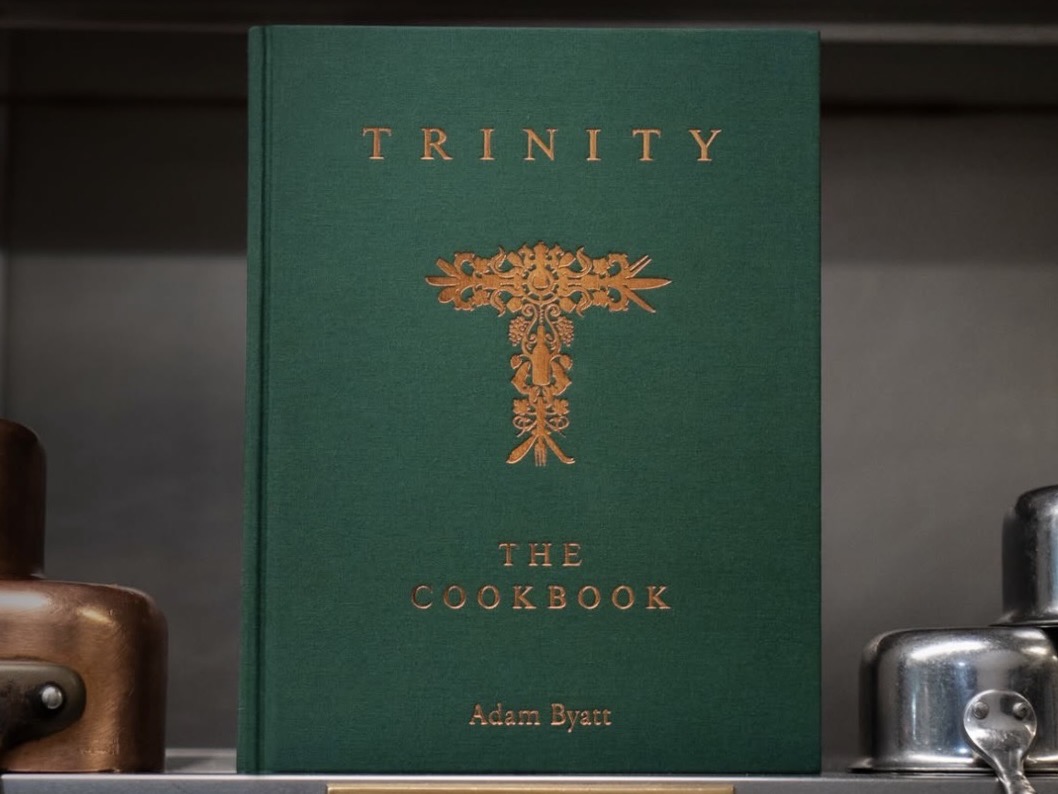
Bound in deep green cloth, stamped with copper lettering and accompanied by Amy Gordon’s illustrations, Trinity: The Cookbook has the appearance of a house archive and the practical intent of a kitchen manual. At a time when restaurant books often choose between spectacle and usefulness, Adam Byatt has attempted to preserve both. The result is a portrait of a restaurant expressed through its dishes, its service and the knowledge it has accumulated. After twenty years, Trinity’s most lasting service may be the one that leaves the dining room and continues in someone else’s kitchen.