
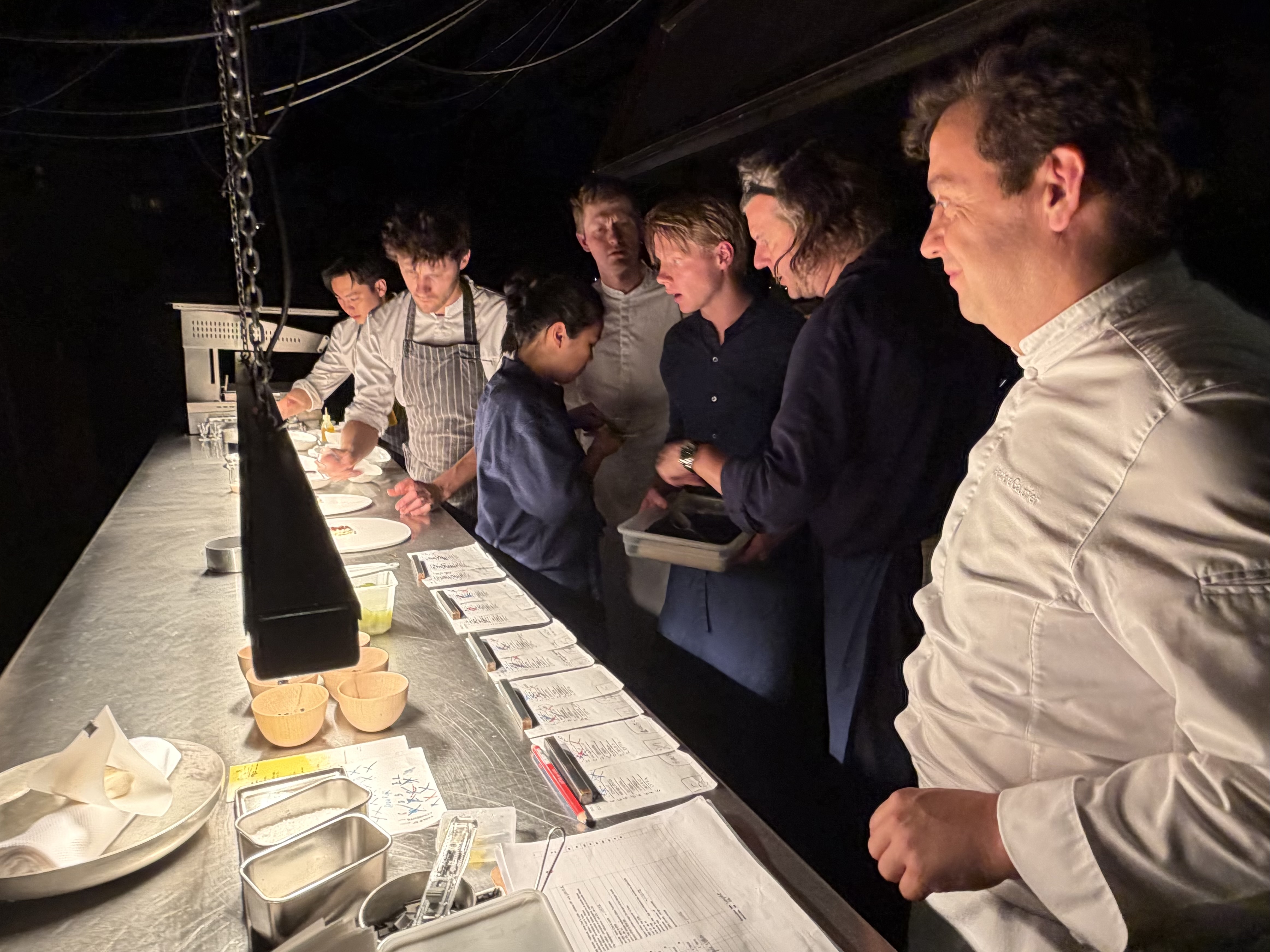
Four-hands dinners have become a familiar part of contemporary gastronomy. A chef travels, enters another kitchen for a night and brings part of his own repertoire with him. At La Grenouillère, on 14 September, Alexandre Gauthier welcomed Gert De Mangeleer and Joachim Boudens of Hertog Jan for an evening that followed exactly that principle, but with the ease that comes from a relationship built over many years.
Gert De Mangeleer has been a regular guest at La Grenouillère for well over a decade and has long expressed his admiration for Alexandre Gauthier and his cuisine. That personal attachment was one of the reasons behind the dinner. After a first collaboration in Antwerp in June, this second evening reversed the roles: Alexandre Gauthier was now receiving Gert De Mangeleer in his own kitchen, at one of the most distinctive restaurants in France.

The intention was written into the menu itself:
“Faire et surtout faire ensemble… découvrir l’autre, son esprit, son univers… et partager et fêter ce partage…”
“To cook, and above all to cook together; to discover the other, his spirit and his world, and to celebrate that exchange…”
The menu reflected that idea without trying to erase either chef’s identity. Both brought dishes, references and signatures from their own cooking. Some plates clearly belonged to one universe, others allowed the two approaches to meet more closely. What made the evening work was the way those different expressions followed one another without creating a break in the meal.

Alexandre Gauthier’s cooking remained immediately recognisable. His cuisine at La Grenouillère is rooted in the Côte d’Opale but never restricted by it. Vegetables, herbs, acidity, bitterness, smoke and unexpected textures often shape the plate as much as the main ingredient. There is something instinctive in the way his dishes are constructed, sometimes direct, sometimes difficult to anticipate, but always connected to the place in which they are served.
Gert De Mangeleer brought a different language. At Hertog Jan, precision and structure are central to his work, together with Asian and particularly Japanese influences that have become part of his culinary vocabulary over the years. His plates tend to be tightly composed, with a clear attention to balance and detail. Beside Alexandre Gauthier’s more instinctive approach, the contrast was visible, but never forced.
Joachim Boudens completed the evening through the wine pairings, bringing another dimension to a collaboration in which the relationship between the dining room and the kitchen has always been important.

The menu opened with Explosion de caviar, followed by Coquillages, Toro no toro, Jardin d’été and a savoury meringue. Faisselle and sturgeon roe led into a series of smaller preparations around frozen textures, cacao, almond, crystal vinegar and fig leaf. The first part of the dinner already established the rhythm of the evening: generous products, but rarely left alone, constantly balanced by acidity, freshness or vegetal notes.

Later came Fond de saladier, shrimp, Bœuf sans bœuf, purple langoustine and a soufflé with red sorrel. The Tomate de collection ’26 brought together different varieties, colours and levels of ripeness in a plate that appeared simple but relied on precise seasoning and texture. Porcini and cuttlefish followed, served with cannelloni and smoked garlic gel.

The Kagoshima A5 wagyu was one of the most immediately recognisable moments of the menu, but it was never treated as an ingredient that needed to carry the entire dish through prestige alone. The same was true of the mallard that followed, accompanied by a split jus, green galette and gnocchi. Across the savoury sequence, caviar, langoustine, wagyu and game all found their place without turning the dinner into a succession of luxury products.

The interest was also in recognising where each chef had chosen to remain himself. There was no attempt to disguise the origin of every idea or to make the menu appear as though it had been written by a single hand. Some signatures were clearly Alexandre Gauthier’s, others clearly Gert De Mangeleer’s. Between them, the progression remained coherent enough for the dinner to feel complete rather than assembled.


The desserts continued in the same spirit: frozen puff pastry, raspberry, rose and vanilla, followed by fig and wine jus, transparency, opaline and frozen preparations. The evening eventually ended with one of its most personal references, Gaufre de Bruxelles, de ma grand-mère, a dish rooted in De Mangeleer’s own memory.

That final gesture suited the dinner. After a long menu built around two chefs and two established cuisines, there was no need for a grand conclusion. The pleasure came from seeing those identities placed next to each other and, at but also brought together.
For Gert De Mangeleer, cooking at La Grenouillère also carried a particular meaning. He was not discovering the restaurant for the occasion. He had been coming there as a guest for years, had followed Alexandre Gauthier’s work and had chosen to return to the table long before entering the kitchen. This time, he was cooking in a place he already knew from the other side of the pass.
A late-summer dinner built around friendship, mutual respect and two culinary languages that did not need to become one in order to work together. At La Grenouillère, the four-hands format simply became what it should be at its best: an opportunity for each chef to bring his own cooking, and for the menu to find its balance between them.
