There is something unusual about Clos de Vènes before the first bottle is even opened. Sylvie and Christophe Jacquel did not inherit a domaine, a cellar or a family method they were expected to preserve. When they arrived in Saint-Couat-d’Aude in 2011, the original project was not about wine but hospitality. The vineyard came later, first almost by accident, through a few abandoned vines and a growing curiosity about the land surrounding them. The garage Christophe had imagined for his collection of old cars gradually became a cellar.
Fourteen vintages later, Clos de Vènes has become an eleven-hectare estate between Minervois and Corbières, producing around 25,000 bottles a year. The vineyards are farmed organically, no grapes are purchased outside the estate, and many of the vines are several decades old. Yet the most revealing part of the project may be the way the Jacquels have chosen to interpret what they found here.

Rather than building the identity of Clos de Vènes around the traditional logic of southern French blends, they have progressively turned their attention towards individual grape varieties. Grenache, Carignan, Mourvèdre and Syrah are approached separately, parcel by parcel. The question is not simply about what these grapes can contribute to a final assemblage, but what happens when each one is given enough space to express his identity.
That freedom is also reflected in the decision to work largely under Vin de France rather than allowing the “appellation d’origine controlée” to dictate the shape of what should be done. It gives Clos de Vènes space to follow the vintage, the parcel and the grape rather than a predetermined formula.

The domaine has also found an early connection with gastronomy. Its wines entered the cellar of Gilles Goujon at L’Auberge du Vieux Puits in 2014 and later appeared at other gastronomic tables. It makes sense. These are wines concerned less with immediate aromatic demonstration than with texture, ageing and the way a bottle evolves alongside food.
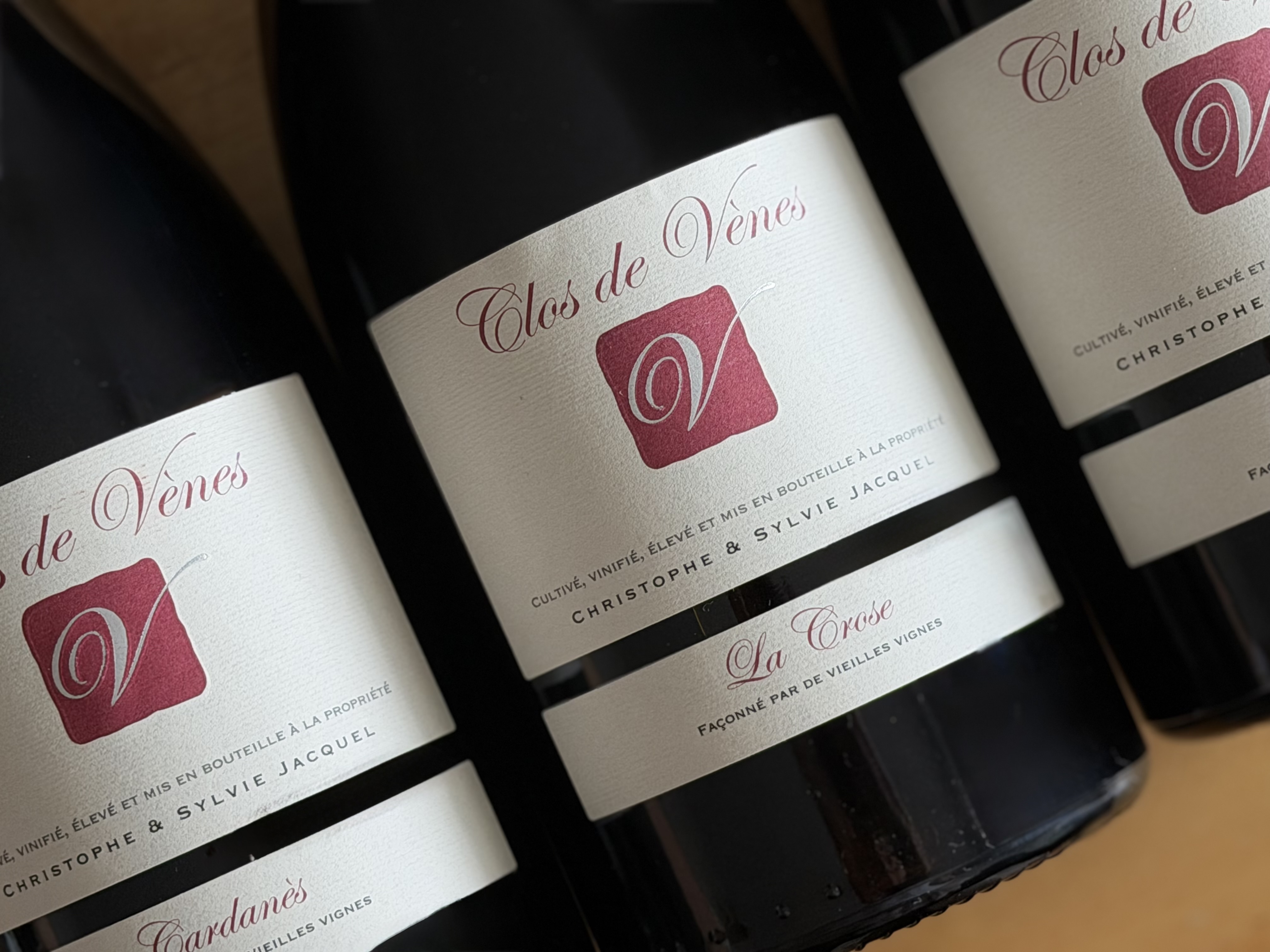
Three bottles make that approach particularly clear and we had the change to taste them: Le Peyra, La Crose and Cardanès. Three old-vine cuvées. Three varieties and three very different readings of the same southern landscape.

Le Peyra 2023
Le Peyra 2023 is built around Grenache, harvested on October 10 and fermented partly in stainless steel and partly in barrel before twelve months in 300-litre casks. At 15% alcohol, the wine clearly belongs to the Mediterranean, but its interest lies in the way that ripeness is carried. Ripe black cherry, plum, dried herbs and warm spice lead the aromatic profile, while the élevage works more on texture than flavour. Nothing feels over-extracted or unnecessarily marked by wood.
On the palate, Le Peyra tannins are already polished, the mid-palate remains supple, and the wine retains enough freshness to prevent its generosity from becoming heavy. The finish is warm and spicy rather than strictly fresh, but the different elements remain connected. It is the most immediately open of the three wines tasted, and probably the easiest to understand from the first glass.
It can be enjoyed now, ideally after an hour in a decanter and served around 17°C, but there is no urgency. A few more years should bring greater complexity without sacrificing the softness that defines it today. I would expect its most interesting window to open around 2027 and through the beginning of the next decade.

La Crose 2023
La Crose 2023 comes from Carignan harvested in two stages, on October 6 and 16, before fermentation in stainless steel and twelve months in 300-litre barrels. At 14.5%, it carries slightly less alcoholic weight than Le Peyra, but feels more structured. The nose is less immediately expansive, moving through dark cherry, blackberry, liquorice, dry herbs and spice rather than pure fruit.
Its real character appears on the palate. The tannins have more grain and remain present through the whole tasting, giving the wine a firmer architecture without making it austere. There is depth rather than volume, and a slightly bitter, savoury note on the finish that gives La Crose a particularly gastronomic profile. Carignan is not softened into anonymity here; its texture is what gives the wine its identity.
The wine is already drinkable, but this is the bottle that may benefit most visibly from a little patience. Decanting helps today, especially if served young, but another two or three years should allow the tannins to settle further. From 2027 onwards, La Crose should enter a more harmonious phase while retaining enough structure to age comfortably into the early 2030s.

Cardanès 2023
Cardanès 2023 is the deepest and most reserved of the three. The Mourvèdre was harvested on October 16, fermented in stainless steel and aged for twelve months in 300-litre barrels. At 15.5%, it is also the most powerful on paper, yet the wine is defined less by weight than by the way that weight is held. Black plum, blackberry, dark cherry, pepper and dried Mediterranean herbs appear gradually rather than all at once.
The palate is dense and structured, with firmer tannins and a slower development than either Le Peyra or La Crose. Its freshness should not be understood as lightness, but as the ability to remain mobile despite full ripeness and that tension is what keeps the wine from becoming static. The finish is long, dark and savoury, with enough bitterness and spice to extend the wine beyond its fruit.
Cardanès can be opened now, but it is the bottle I would most readily leave in the cellar. Two hours in a decanter already help separate fruit, tannin and warmth, yet the wine still feels at the beginning of its evolution. From 2028 onwards, it should gain another level of complexity, and well-stored bottles should continue to develop well into the following decade.
Three grapes, but also three different moments
Tasted together, the 2023s make the philosophy of Clos de Vènes easier to understand. The difference does not begin only with Grenache, Carignan and Mourvèdre. It begins with time. La Crose starts harvesting on October 6, Le Peyra follows on October 10, while Mourvèdre waits until October 16, the same day the final Carignan parcels are picked. Three varieties, three moments of maturity, and three different ways of reaching balance within the same vintage.
The cellar then provides a common framework, separate vinifications, restrained extraction and twelve months in 300-litre barrels without forcing the wines towards the same result. Le Peyra is the most immediate, built around amplitude and suppleness. La Crose is more tactile, its identity carried by tannic grain and a savoury finish. Cardanès moves more slowly, with greater depth and a structure that clearly asks for time. Even their alcohol levels (14.5%, 15% and 15.5%) matter less than the way each wine manages that ripeness.
Tasted side by side, the three wines seem to move at different speeds. Le Peyra gives itself first, La Crose takes shape through texture, Cardanès keeps more in reserve. The same vintage passes through each of them differently. At Clos de Vènes, that difference is not corrected in the cellar. It is allowed to remain visible.