
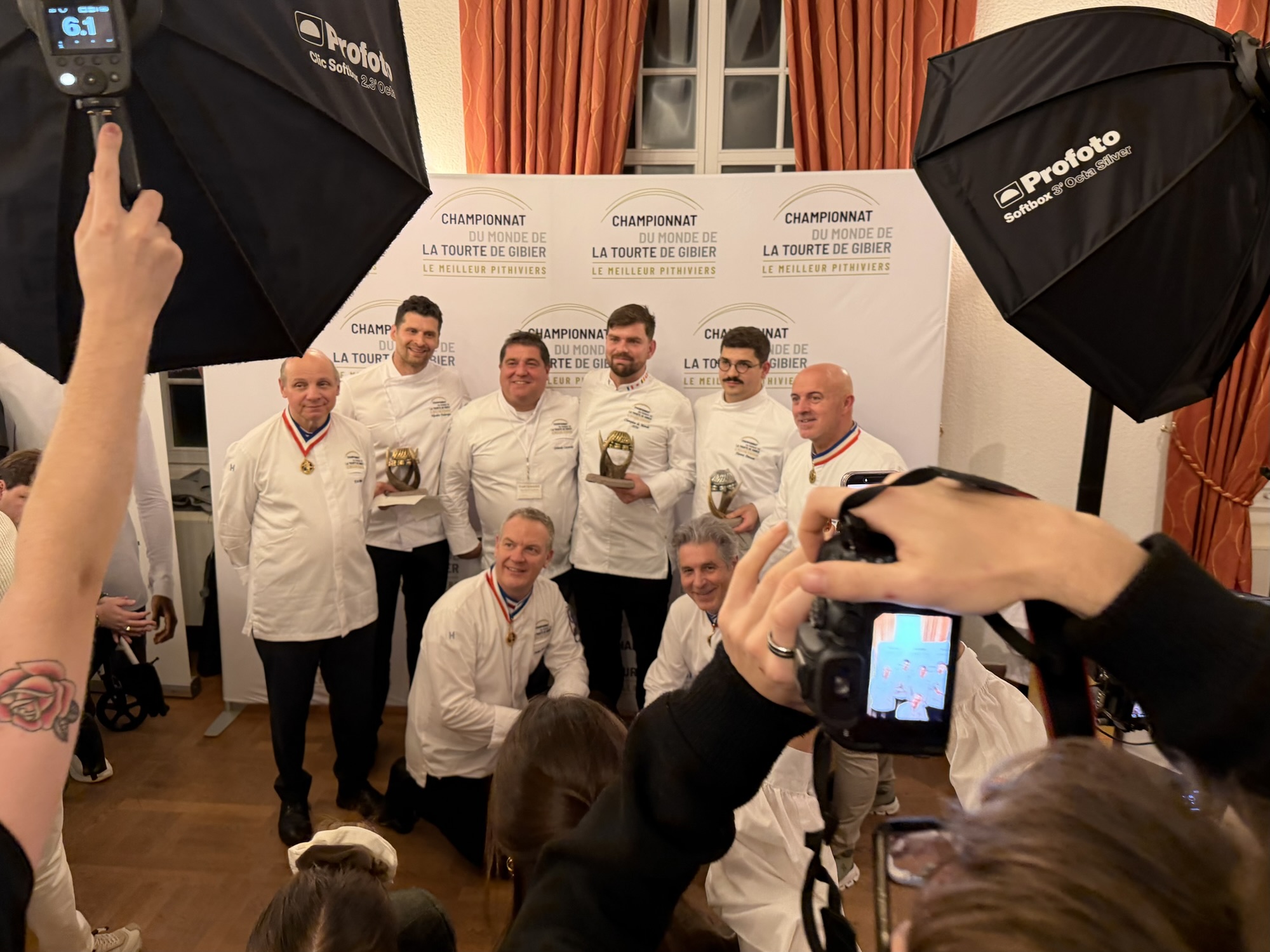
Louis Renier of La Chèvre d’Or in Èze has won the second edition of the Championnat du Monde de la Tourte de Gibier – Le Meilleur Pithiviers, held on October 27, 2026, at Le Chambard in Kaysersberg, Alsace.
Eight chefs gathered in Olivier Nasti’s kitchens for a competition devoted to one of the most demanding preparations in French game cookery. Florent Peresse of Les Prés d’Eugénie took second place, while Nicolas Delaroque, who travelled from San Francisco to represent Maison Nico, finished third.
Created by Olivier Nasti, Éric Briffard and Fabien Pairon, all three Meilleurs Ouvriers de France, the championship has attracted competitors from all around the world after only two editions. Its ambition comes from a shared attachment to game, pastry and the traditions of French charcuterie.
Michel Roth, Bocuse d’Or 1991 and Meilleur Ouvrier de France, served as honorary president, alongside a jury bringing together chefs and specialists whose careers have been closely connected to these disciplines.

Championnat du Monde de la Tourte de Gibier 2026 – Results
● World Champion: Louis Renier – La Chèvre d’Or, Èze, France
● Second Place: Florent Peresse – Les Prés d’Eugénie, Eugénie-les-Bains, France
● Third Place: Nicolas Delaroque – Maison Nico, San Francisco, United States
● Best Commis: Romain – CFA de Colmar, France
The candidates had four hours to prepare their game pithiviers, with only the pastry and marinades allowed to be made beforehand. Everything else had to take shape in the kitchens of Le Chambard, from the composition of the fillings to the final assembly and cooking. Feathered and furred game were both permitted, giving the competitors considerable freedom in their choice of ingredients. What emerged was a collection of preparations that shared the same culinary foundations but differed in their construction, techniques and interpretation.
For Éric Briffard, who helped bring the pithiviers back into the French restaurant repertoire during the 1990s, the essential question remained the pleasure of eating. A successful preparation needed crisp pastry, juicy meat, fragrance and flavour, regardless of the complexity involved in producing it.

Fabien Pairon spoke of the distance between a pithiviers prepared at home, one designed for a restaurant menu and the exceptional pieces presented in competition. The latter demand a degree of precision that can surprise even experienced professionals, particularly when several ingredients must reach their ideal texture at the same moment.
That difficulty was also raised by Vincent Ferniot, a member of the tasting jury. Unlike a pâté en croûte, a game pithiviers must be served hot, making the relationship between pastry, game, foie gras and vegetables particularly delicate. The different elements do not respond to heat in the same way, and the result depends on finding the right balance between them. Vincent Ferniot also noted how the international candidates had approached the preparation through the traditions of French game cookery, bringing their own experience without losing sight of the dish they had come to prepare.

The final brought together chefs working in France, Switzerland, Japan and the United States. Among them were Go Ishii of Monolith in Tokyo and Romain Desvenain of Geneva, alongside candidates from several French restaurants. Their presence reflected the reach of a preparation that remains closely associated with French culinary heritage, particularly in Alsace, where hunting and game have long occupied an important place at the table.
For Louis Renier, the announcement carried an unexpected weight. Standing on stage to receive the trophy, he explained that just over 24 hours earlier, he had not been certain he would be able to take part in the competition. His victory followed that of Sébastien Guérin, the inaugural champion in 2025, who returned this year as a member of the jury. In two editions, the championship has already begun to establish a relationship between its former winners, competitors and the chefs who created it.

The organisers also gave particular attention to the young chefs who worked alongside the finalists. Students from the CFA in Colmar had volunteered during their school holidays, assisting the competitors throughout the four-hour challenge. The Best Commis Award was presented to Romain, recognised for his commitment and the support he provided during the competition. The candidates themselves were assessed in part on the way they worked with their assistants, an important detail in a profession where the transmission of knowledge depends as much on behaviour as on technique.