
Just outside Reims, in Tinqueux, Arnaud Lallement has spent more than twenty-five years building one of the most complete restaurant we have ever had the chance to visit. There are three Michelin stars, of course, but reducing the place to its distinctions would miss much of what makes it remarkable. L’Assiette Champenoise is a family house, a restaurant, a hotel, a garden and a cuisine built around extraordinary precision and, increasingly, a place where several generations are beginning to overlap.

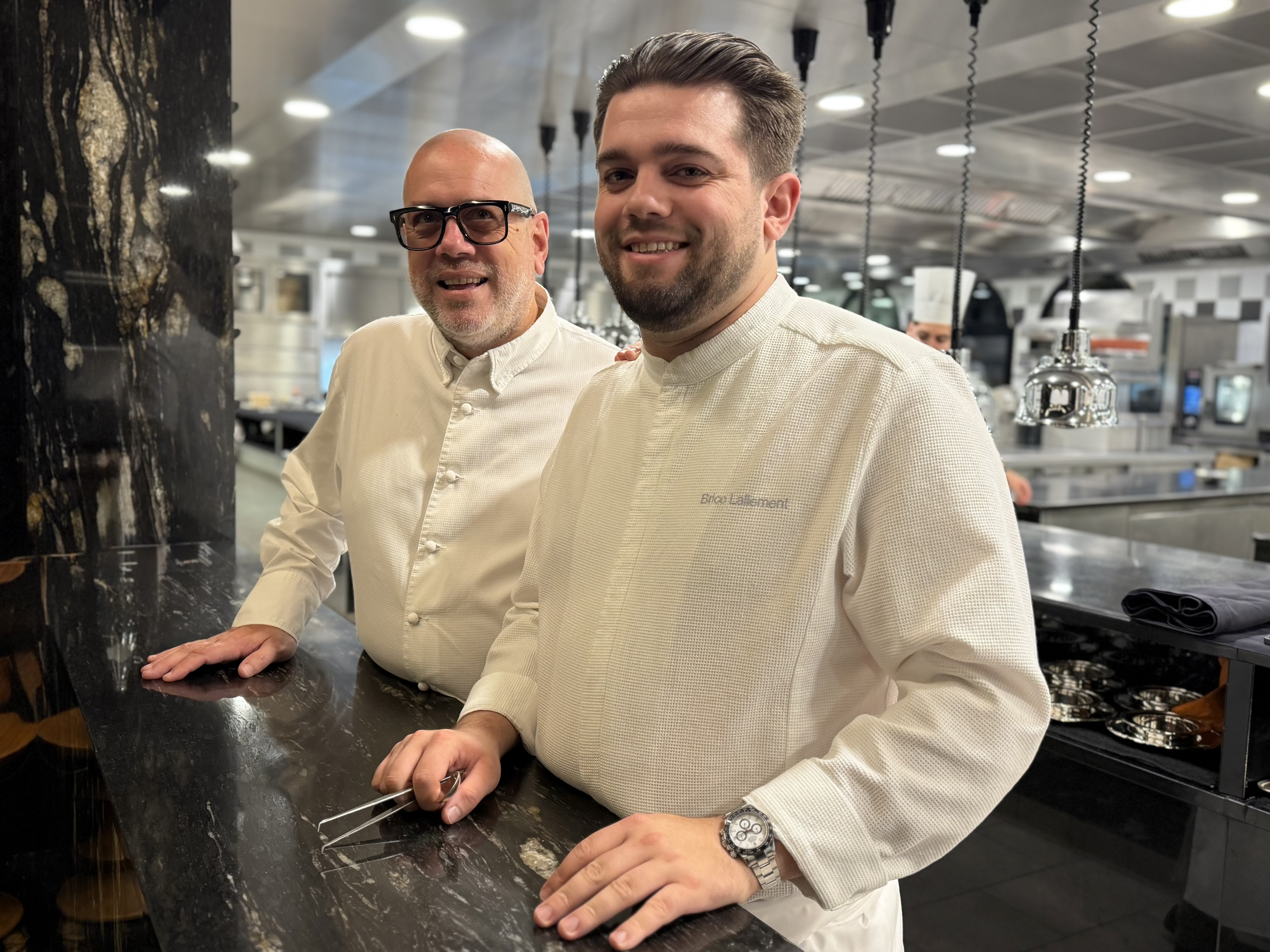
We spent an evening inside the kitchen at the Chefs Table, talking with Arnaud Lallement and his son Brice while the service unfolded around us. It created a rare perspective. At moments, it felt less like visiting a restaurant than being allowed inside the life of a living house.

Arnaud Lallement has a remarkably simple word to describe his cuisine: “gourmande.” And it is perhaps the most accurate one.
The sophistication is however evident everywhere – maturations, fermentations, reductions, garums, sauces built over time, precise temperatures – yet none of those techniques seems intended to become the subject. They exist to make you want another bite.
Arnaud Lallement speaks about dishes that remain in memory not because they demanded admiration, but because once the plate was empty, you wished there were still something left. He dislikes the word “classic”, which he feels suggests something fixed, almost untouchable, and prefers “timeless”: a dish can remain for years while continuing to change almost imperceptibly, responding to a new season, a better technique, a different acidity or simply to the person the chef has become.

The lobster is perhaps the clearest example. It has accompanied Arnaud Lallement for many years and has known numerous versions, yet its identity remains recognisable: lobster, potato and the depth of a shellfish jus. The construction can evolve around it, but the product must never disappear. Elsewhere, the restaurant reveals a side that can be more surprising for anyone arriving with an image of an established French three-star house.
Tomato becomes miso, water, gel, leaf sauce and condiment. Matured tuna meets garum, spice and acidity in a plate with remarkable length. Caviar, smoked haddock and potato are built around temperature and texture, while pigeon can move towards the intensity of Kalamata olive without ever losing its place at the centre of the plate.

There is considerable energy in this cuisine. Acidity is pronounced, spices appear confidently, and fermentation and maturation have now become part of the restaurant’s vocabulary. Yet there is little sense that L’Assiette Champenoise is following a movement simply because the rest of gastronomy has moved in that direction. Arnaud Lallement resists the need to put cuisine into categories. His cuisine evolves because he evolves, because the seasons in Champagne and products available change, because and because curiosity has remained intact after more than two decades at the head of the house.

Time therefore becomes one of the most interesting threads of the evening. Arnaud Lallement speaks with genuine pleasure about getting older. Each decade, he explains, has brought something that the previous one did not possess. When he was younger, he was more impatient, more demonstrative and perhaps more interested in proving something through his plates. Age has introduced another form of confidence. A reduction can take the time it needs. An ingredient can be left alone when nothing needs to be added. The same evolution can be felt in the way he thinks about people and about the restaurant itself.
Arnaud Lallement speaks openly about the kitchens in which his generation was trained and about behaviours that were once accepted almost without question. He shouted, things were thrown, fatigue was treated as an unavoidable part of the profession. He does not romanticise that period. Over time, L’Assiette Champenoise has reorganised its teams around different schedules, allowing morning and afternoon brigades to overlap rather than asking the same people to carry the entire day. His reasoning is direct: when fatigue decreases, much of the negative stress disappears with it. The restaurant’s kitchens have also been conceived around movement, ergonomics and the distances cooks travel during service, while production areas, fermentation rooms and other technical spaces continue to evolve out of sight. Much of the investment made in the house will never appear in a photograph, yet it is central to the way the restaurant functions.

Hospitality follows the same logic. Arnaud Lallement does not believe every guest wants to hear a technical explanation before tasting a dish. The team knows the details and can go further whenever someone wants to understand more, but a few words are often enough. People come to eat, drink, celebrate, talk and spend time together. Birthdays, anniversaries, engagements, promotions or simply the desire to share dinner remain part of the reason restaurants exist. In an era when fine dining often speaks about creating an “experience”, Arnaud Lallement’s position feels refreshingly simple: the restaurant experience should accompany the moment rather than compete with it.
This is also why he remains so close to the dining room. He watched his father do the same thing, and regular guests still contact him directly. Some reservations arrive by telephone or text message directly to him because people who have been coming for years do not necessarily want another digital layer between themselves and the house. Relationships survive through attention, and at L’Assiette Champenoise that attention extends well beyond what happens on the plate.

Beside him now is Brice Lallement. At twenty-seven, he is increasingly present in the kitchen of the family house where he grew up. The hotel was once his playground. He learned to swim in the pool, cycled around the property and spent holidays inside a place that, for other people, was already a destination. Cooking eventually became his choice rather than something imposed by the family. When Brice says, “It really is my home,” the sentence explains much of what is happening today at L’Assiette Champenoise.

Arnaud Lallement approaches the subject of transmission carefully. A family story continuing into another generation is beautiful, he says, but nobody should lose themselves inside it. One son chose another path; Brice chose the kitchen. There is no theatrical handover taking place and no symbolic date by which one generation must disappear for another to begin. Father and son may work together for years. Arnaud Lallement himself did not experience this kind of prolonged overlap with his own father, and there is something moving in the idea that Brice may now receive what Arnaud never fully had: time.

Transmission here extends far beyond recipes. It means understanding how to read a dinning room, when a guest wants to speak and when to leave them alone, how to manage a team, suppliers, a wine and champagne cellar, a hotel and the financial realities of a property of this scale.
It also means preserving enough strength for the next generation to continue making choices of its own. Watching Arnaud and Brice Lallement during dinner, it becomes clear that L’Assiette Champenoise is living through a particularly interesting moment as the past is present everywhere without nostalgic.

Arnaud Lallement often returns to one principle: never forget where you come from, where you are, and for whom you are doing it. Where he comes from is the restaurant created by his parents, Jean-Pierre and Colette Lallement. Where he is is Champagne. And for whom he does it is the guest sitting at the table. That idea explains the house better than any list of distinctions. L’Assiette Champenoise remains one of the most beautiful three-star restaurants we have had the chance to visit, not only because of the precision of its cuisine or the elegance of the property, but because the entire place still feels alive, still questioning itself and still moving forward.

By the end of the evening, after the plates, the conversations and the movement of service, the restaurant had become something more intimate than the image we had of it before arriving and time seemed to slow down just enough to understand why some restaurants become destinations and while other also eventually become houses to which people want to return.