What if the most important thing in a restaurant was not what happened in the kitchen, but what happened around the table?
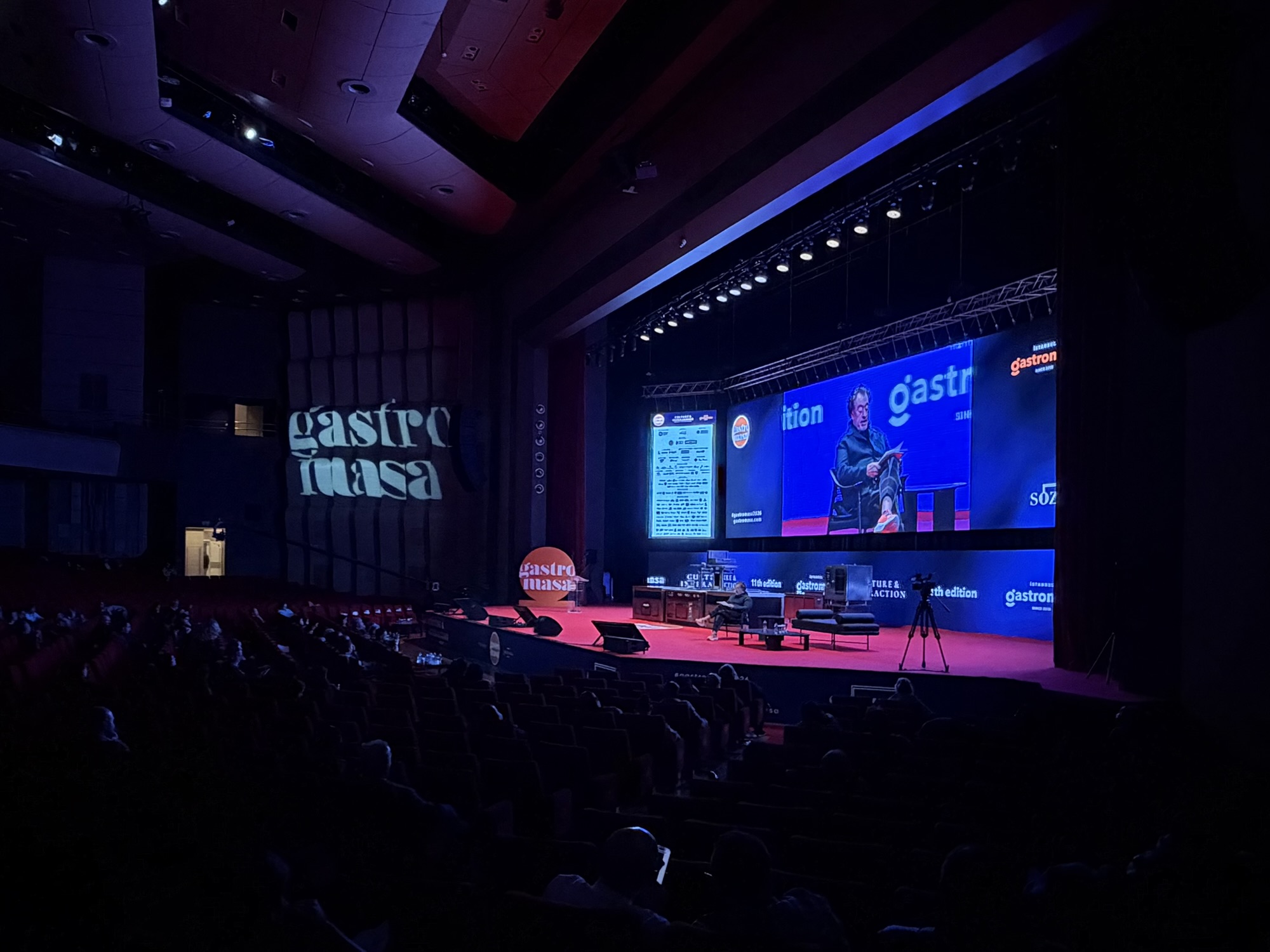
Speaking at Gastromasa 2026 in Istanbul, Bruno Verjus, chef, novelist and founder of the two-Michelin-starred restaurant Table in Paris, offered a reflection on hospitality through the intertwined worlds of literature and cuisine. Drawing on Homer, Marcel Proust, Karen Blixen, his own novel La Recette and his experience as a restaurateur, the French chef approached the conference’s theme, Culture & Interaction, from a deeply human perspective: how can we welcome another culture without renouncing our own?
Bruno Verjus – The table where strangers become human to one another
Introduction – A chair pulled out
Good evening, everyone.
I would like to begin not with a table, but with a chair.
Imagine someone pulling out a chair and saying: “Sit down. There is a place for you.”
It is a very small gesture. It takes only a second. And yet, in that second, something important may happen: a stranger becomes a guest.
I have spent a large part of my life around tables. First as someone who loved eating. Then as someone who wrote about food. And, rather unexpectedly, as a chef. I am also a novelist.
And over the years, I have come to believe that the table may be one of humanity’s oldest inventions for transforming a stranger into a guest. Not because we eat there. Animals eat. Sometimes together. Sometimes with rather bad manners. But because something else happens when human beings sit around a table. We talk. We listen. We argue. We laugh. We fall in love. We make peace. And sometimes, we discover that the person sitting opposite us is no longer simply a foreigner, an adversary, or a category. They have become a face. A voice. An appetite. A presence.
This afternoon, I would like to explore a simple idea: perhaps literature and cuisine share the same secret.
Both allow us to enter another person’s world without asking them to abandon their own.
I would like to do this through three tables.
The table of literature, where characters meet and reveal themselves.
The table of my novel, La Recette — The Recipe, where a young Cantonese woman named Miki encounters Paris without renouncing where she comes from.
And the table of my restaurant in Paris, which is called, quite simply, Table.
But one thing must be clear from the beginning: the table does not erase differences. At its best, it teaches us how to welcome them.
1. The first table – Hospitality before judgement
Let us travel back a few thousand years. In ancient Greece, hospitality was not simply good manners. It was a sacred obligation. The Greeks had a word for it: xenia. It described the relationship between host and stranger, protected by Zeus himself. A traveller could arrive at your door without an invitation, without a recommendation, and certainly without an online Zenchef or OpenTable reservation.
You were expected to welcome him. Offer water, food, a place to rest. And only then, ask who he was.
I find this order extraordinary. First, you feed the stranger. Then, you ask his name.
Today, we often do the opposite. We want to know who someone is, where they come from, what they believe, and whether they agree with us. Only then do we decide whether they deserve a place at our table. The ancient Greeks understood something essential: hospitality must come before judgement.
In Homer’s Odyssey, offering food repeatedly establishes a relationship between people who do not yet know one another. The meal is not merely a pause in the adventure. It is part of the moral architecture of the world.
To welcome someone is to recognise their humanity before knowing their identity.
Of course, the Greeks were not always exemplary hosts. Their mythology is full of people who behaved appallingly at dinner. But perhaps that is precisely why they needed such a powerful ideal. Civilisation does not begin when everyone agrees. It begins when we decide that disagreement is not a reason to refuse someone bread.
2. Literature – The table as a theatre of humanity
Writers have always understood the power of the table. Not only because writers are often hungry — although I suspect many of them are. But because a table is an extraordinary literary device. A novelist can bring together people from different classes, generations, religions and countries, place them around a table, and wait. Sooner or later, something will happen.
At a table, the world becomes visible. Think of Plato’s Symposium. A group of men gather for a banquet in Athens. They drink wine and discuss love. More than two thousand years later, what survives is not the menu. It is the conversation.
A meal has become one of the founding texts of Western philosophy. And I rather like the idea that philosophy, which sometimes takes itself very seriously, owes so much to a dinner party.
In Balzac’s novels, the dining table becomes a map of society. What you eat, where you sit, who serves you, and who is invited reveal the structures of power, wealth and ambition. Food is never entirely innocent.
A dinner can expose a society more efficiently than a political speech.
And then there is Proust. The famous madeleine. A small cake dipped in linden tea, releasing an entire lost world.
What interests me is not simply that taste awakens memory. It is that taste abolishes distance. Between childhood and adulthood. Between the living and the dead. Between what we thought we had forgotten and what was secretly waiting inside us. One mouthful, and time collapses.
And so I created my madeleine. I wanted to capture a feeling of springtime happiness on the shores of the Mediterranean, at that precise moment when the olive, almond and citrus trees are blooming.
There, between the scent of blossoms, the sea spray and the lightness of the air, the threads of a fragrance come together, with its top, heart and base notes. But even the most vivid memory eventually fades.
Only one bite could hold it a little longer. The madeleine.
Literature does this with words. Cuisine does it with matter.
And then there is one of the most famous examples: Babette’s Feast, the story by Karen Blixen.
Babette, a French refugee living in a strict religious community in Denmark, prepares an extraordinary dinner. Her guests begin the evening constrained by suspicion, old grievances and religious austerity. But gradually, through the meal, something changes. People soften. Memories return. Resentments lose their power. Pleasure becomes a form of reconciliation.
Babette does not give a speech about tolerance. She cooks, and that is enough to change the atmosphere of an entire community. What moves us is that she does not demand that her guests become different people before they can share the meal. She welcomes them as they are.
The finest hospitality does not insist that people change their minds. It creates the conditions in which they might open their hearts.
3. The great migrations of taste
There is another reason why I believe the table brings people together.
Food has never respected borders. We speak of French cuisine, Chinese cuisine, Italian cuisine or Turkish cuisine as though they were perfectly defined territories. But the history of food tells a very different story.
Consider the tomato. Today, it seems impossible to imagine Italian cuisine without tomatoes. And yet tomatoes came from the Andes in South America. For centuries, Italian cooks had never seen one.
Imagine explaining to an Italian grandmother that her beloved tomato sauce is, among other things, a consequence of globalisation. She might not appreciate the historical accuracy.
Or consider the potato: another Andean plant from Lake Titicaca that became central to the diets of Ireland, Germany, France and much of Europe.
Or chilli peppers. Originating again in the Americas, they travelled across oceans and became essential to cuisines throughout Asia. Today, Korean or Indian cooking without chilli would seem almost unimaginable, and yet the chilli is a relatively recent guest in Chinese culinary history.
And let us go back to 1669, when Soliman Aga brought the aromas of Eastern coffee to the court of Louis XIV.
Served in a delicate porcelain cup, this dark, slightly bitter, steaming brew promised neither the intoxication of wine nor the pleasures of love. Only wakefulness.
And soon, over a little cup of black coffee, France discovered a new way to talk, think, dream — and stay awake long enough to disagree.
This leads me to a slightly provocative idea. A supposedly pure cuisine would not be a cuisine that had preserved its entire history. It would be a cuisine deprived of a large part of it.
What we call culinary tradition is often the memory of an encounter that succeeded.
Of course, these journeys were not always peaceful. Trade, conquest, colonialism, forced labour and migration all shaped the movement of ingredients.
We should never romanticise that history. But we can recognise something remarkable. Once an ingredient arrives in a new place, people begin to make it their own. They adapt it. They give it a new language. They attach new memories to it. And sometimes, after a few generations, they cannot imagine life without it.
Cuisine is not a museum of pure identities. It is a living history of exchange. That is why I have always been suspicious of the idea of culinary purity. Purity is a strange ambition for something as alive as food.
A cuisine that refuses every encounter may cease to be alive.
4. Miki – Becoming more, not becoming less
This brings me to Miki, the young woman at the centre of my novel La Recette. Miki comes from a Cantonese world. She carries with her a particular relationship to food, texture, memory, family and the discipline of gestures.
Then, for various reasons, she encounters Paris. And, through Paris, another culinary civilisation. But I did not want to write the familiar story of a young Chinese woman arriving in France, discovering butter and cream, and suddenly becoming enlightened. That would be both ridiculous and rather insulting to Chinese culinary knowledge.
Miki does not need France to teach her what taste is. She already knows. She comes from one of the world’s greatest culinary cultures. She does not arrive empty. What she discovers is another way of expressing something she already understands.
In the novel, she follows the traces of an old culinary notebook. At one point, her journey brings her to a praline tart — and to a mysterious number written in the notebook: 1, 2, 3.
At first, it is simply an enigma. A number among ingredients, gestures and instructions. Then it reveals its meaning: 123 degrees Celsius. A temperature for cooking sugar. On the page, it is almost nothing. Three digits. And yet, through those three digits, an entire world opens.
Behind that number is the intelligence of a hand. The memory of a cook. The patience of someone who repeated a gesture thousands of times. Perhaps also the love of someone who once prepared this dish for another person.
Miki begins to understand that a recipe is never only a list of ingredients, temperatures, proportions and techniques. A recipe can be a hand extended across time. Someone who is no longer there can still guide your hand. Someone you have never met can still teach you how to pay attention.
The smallest technical detail can contain an immense human story. A temperature is never just a temperature. It is the accumulated knowledge of generations.
And this changes Miki’s relationship to French cuisine. At first, she may believe that she must learn how to reproduce it. Gradually, she understands that she can enter into conversation with it.
She discovers connections between a French sauce and a Chinese broth. Between the precision of Cantonese steaming and the almost invisible cooking of a fish in a French kitchen. Between the discipline of Chinese painting and the composition of a plate. Between a childhood memory and an entirely new sensation.
Paris does not replace Canton. Paris enters into conversation with Canton.
Miki gradually becomes Parisian. But not by ceasing to be Cantonese. She becomes Parisian by adding Paris to herself. Her identity does not disappear. It expands.
And eventually, she can imagine a cuisine that belongs entirely to her. Not simply Cantonese cuisine. Not simply French cuisine. But the cuisine of a woman who has lived, travelled, loved, remembered and tasted. A cuisine that could exist only because she encountered other people — and allowed those encounters to change her without making her less herself.
That, for me, is one of the most beautiful possibilities offered by culture. We do not have to become less of ourselves in order to welcome something from someone else.
We can become more.
5. Table – A small restaurant with the whole world inside
Now let me take you to my restaurant in Paris. Named Table.
A rather simple name. I could have chosen something more sophisticated. Perhaps something in Latin. Or a mysterious Japanese word. Or my own name written in very large letters. But I chose Table. Because that is where everything happens.
For me, a restaurant is not primarily a place where a chef demonstrates his talent. It is a place where human beings gather to experience something together.
Over the years, people have come to Table from all over the world: Japan, Korea, China, Hong Kong, the United States, Brazil, the Middle East and every corner of Europe. Most of my guests are international.
They do not necessarily speak French. They do not share the same childhood or taste memories. They have not grown up with the same flavours. And yet, for a few hours, we share something essential. A whole piece of fish. A vegetable. A shellfish. A sauce. A fruit. And most of the time, a smile.
I have always believed that a great ingredient possesses a language that precedes words. A perfectly ripe tomato does not need a passport. A beautiful oyster from Utah Beach does not have a religion. A fish cooked with absolute precision does not ask whether you are conservative or progressive.
It simply offers itself to your attention. And in that moment, something becomes possible. People who disagree about almost everything may agree that this is beautiful.
Not always, of course. I have also met people who disagreed with a perfectly cooked fish. Humanity remains a complicated species. But the possibility is there.
My cooking is often described as creative. Yet I do not think of creativity as inventing complicated things. I think of it as revealing what already exists. Removing whatever prevents an ingredient from being itself.
A vegetable should taste profoundly of the vegetable it is, to quote the genius Alain Passard, my brother.
A shellfish should carry the memory of the sea. A fruit should express the place, the season, the light and the weather that made it possible, the flow of the sap.
The cook should intervene with intelligence, but also with humility. Because I do not believe that the role of a chef is to dominate nature. It is to listen, to examine it closely and, ultimately, to establish a relationship with it. And then to share that relationship with others.
This is why I speak of a cuisine du vivant — a cuisine of the living world. It is not simply a culinary style.
It is a way of paying attention. To producers. To landscapes. To seasons. To the soul. To the people who fish, grow, harvest and raise what we eat. And finally, to the people who sit at our table.
When I serve an ingredient, I am also introducing the guest to the invisible people who made that ingredient possible. A fisherman. A farmer. A gardener. A cheesemaker. A whole landscape of human relationships.
A restaurant can therefore become a meeting place between people who will never physically meet.
That, too, is a form of hospitality.
6. The shared table – Learning to enjoy difference
We live in a world that is increasingly connected. And yet, strangely, increasingly divided. We can communicate instantly with someone on the other side of the planet.
But we seem to find it more difficult to listen to the person sitting next to us. We have become experts at identifying differences. Nationality. Religion. Culture. Political opinions. Social class.
We classify people before we meet them. Sometimes, we condemn them before they have spoken.
I am not suggesting that a good dinner can solve every political conflict. If that were true, the world would have been at peace a very long time ago. And chefs would be running the United Nations. Which might be entertaining, but not necessarily reassuring.
Nevertheless, eating together creates a small but essential form of resistance to fragmentation. Because the table imposes a different rhythm.
You cannot experience a beautiful meal entirely through a screen. You must be present, use your senses, accept that the person opposite you exists beyond your own imagination.
You may discover that they have different customs. That they eat things you have never tasted. That they find delicious something you find strange.
And that is wonderful.
Consider the simple act of tasting an unfamiliar dish. At first, there may be hesitation. What is this? How do I eat it? Will I like it? Then comes curiosity. Then the first taste. Perhaps surprise. Perhaps pleasure.
May I quote Brillat-Savarin — Aphorism IX, in La Physiologie du goût, 1825:
“The discovery of a new dish does more for the happiness of mankind than the discovery of a new planet.”
And suddenly, a small border has disappeared. Not a national border. Something more intimate. The border between what we know and what we are willing to discover.
Every new taste is a small act of trust. And trust is where relationships begin.
The purpose of hospitality is not to make everyone identical. It is to prevent difference from becoming a threat. Perhaps even to make difference enjoyable.
This is also why I do not believe that great cuisine should belong only to the wealthy, the educated or the initiated. The table should not become a fortress of privilege. Its highest ambition should be to welcome and nourish. To make people feel alive. To create joy. To give them something they can carry away — not in a bag, but in their memory.
7. The recipe that cannot be written
Let me return to Miki for a moment. She begins by searching for a recipe that already exists. Gradually, she understands that the real recipe is the one she is becoming capable of creating. Through her encounters. Through her memories. Through the people who have fed her. Through the people she will one day feed.
Because a recipe is not a fixed object. It is a possibility.
Anyone who cooks knows that you can follow the same recipe twice and obtain two different results. The tomato is not the same. The weather is not the same. Your hand, your mindset, is not the same. And perhaps, most importantly, the person for whom you are cooking is not the same.
In that sense, a recipe is very close to a musical score. The notes are written. But the music does not exist until someone plays them.
And on top of that, let me quote the pure genius Miles Davis:
“Some people say I am not playing all the notes on my musical score. This is true! I just play the best ones.”
Let me confess that I do the same.
Literature works in much the same way. A novel is written by one person. But it is completed by the reader. The reader brings their memories, experiences and private landscapes. Two people can read the same novel and discover two different worlds. Just as two people can taste the same dish and experience entirely different emotions.
The writer and the chef offer something. But they do not control what the other person receives.
And that is beautiful. Because hospitality requires us to give up a little control. To offer without possessing. To welcome without immediately understanding. To allow the other person to remain free.
Conclusion – A place for you
I would like to finish where I began: with a table, and with a chair.
Imagine an ordinary table. Nothing particularly remarkable. A few plates. Some bread. A bottle of wine. Perhaps a perfectly roasted chicken — my favourite.
Around it sit people who do not know one another. They come from different countries. They speak different languages. They carry different beliefs, memories and fears. At the beginning, they are strangers.
Someone pours the wine. Someone passes the bread. Someone offers a dish. A conversation begins. Perhaps they laugh. Perhaps they disagree. Perhaps one person tells a story that reminds another of their childhood.
No miracle occurs. They do not suddenly become identical. They may leave with the same convictions they had when they arrived. But something more modest, and perhaps more precious, has happened.
They are no longer simply representatives of countries, religions or cultures. They are no longer merely individuals. They share the same food. They have become a community.
This is what literature can do. This is what cuisine can do. And this is what the table makes possible.
Miki does not become Parisian by forgetting Canton. She becomes Parisian by allowing Paris to become part of her. And she enriches Paris by bringing Canton with her.
In my restaurant, I have tried to create a place where the world can come together without anyone having to renounce where they came from.
Because I believe that the greatest luxury is not caviar. It is not truffles. It is not a famous wine.
The greatest luxury is attention.
Attention to the living world. Attention to what we eat. Attention to the hands that made our meal possible. And attention to the person sitting opposite us.
A border tells us where one country ends and another begins. A table reminds us that humanity does not end there.
Perhaps the most important recipe humanity has ever invented is not a recipe for a dish. It is a recipe for living together. It does not begin with an ingredient. It begins with a gesture.
Pull out a chair.
Make room.
And say: “Please, sit down. There is a place for you at my table.”
Thank you.
Bruno Verjus